Sunday, July 20, 2008

Definition,Nature and Scope of Economics

(Question taken from ISC Economics published by Frank Bros for class XI.Suitable for students of ISC Schools.Chapter I,Definition,Nature and Scope of Economics )

1.Explain the nature and scope of Economics.

Introduction
Economics is a social science concerned with answering economic questions. It seeks to explain, systematically, a large variety of questions pertaining to the economic behavior of individuals and groups.

Each leading economists has defined economics a little differently.

Adam Smith : His definition of economics is wealth oriented. His concept of Economic Man said that man tries to increase his economic gain for this self interest.

Alfred Marshall : His definition of economics not only included wealth but also the ordinary business of life. That is he said economics is not only about earning wealth but also about spending money.

Lionel Robbins : His definition of economics says that human want are unlimited but resources to satisfy those want are limited. So, Robbins’s definition says economics studies the relationship between ends and scarce means.

Paul Samuelson : Samuelson’s definition of economic is somewhat similar to that of Robbins. While Robbins was concerned with the relationship between want and means for the short term, Samuelson was concerned with this relationship in the long run.

Nature and Scope of Economics

Nature of Economics :

Is the nature of economics like an art or a science?

Economics as a science: Economics is considered to be as social science. A social science is a science which studies human activities. A subject is called a science if:
a)There is a systematic body of knowledge which traces the relationship between cause and effect.
b)There is observation of facts, systematic collection, classification and analysis of facts.
c)There is a making of generalization on the basis of relevant facts and formulating laws and theories.
d)These theories are subjected to real world observations.

Subjects like Chemistry and Physics are called science because it meets all the above characteristics. Economics can also be called a science since it meets these features of a science. Like in other sciences, economic theories are deduced by logical reasoning. For example, like in Newton’s Law of Gravitation in Physics, in economics, the Law of Demand states that, other things remaining the same, there will be an increase in demand if there is a reduction in the price.

Like in other sciences, in economics too there is observation of facts and an analysis of the same. Like other sciences in economics too theories are subjected to real world observations. The truth of economic theories can be challenged when these are subjected to real world observations. Since the methods of economics are scientific it is called a science. Economics is a Positive Science and a Normative Science. This is because it is concerned not only with the cause and effect relationship but also with the cause and desired effect relationship.

However, like in other sciences, laboratory experiments are not possible. Also the laws of economics are not universally applicable like other sciences. Therefore while economics is a science, it is not an exact science.

Economic as an Art : Economics is also an art. It is an art. It is an art because it is not only theoretical but also practical. Science is about knowledge. Art is the application of knowledge.
Applying this definition of art we can say economics is an art because the various branches of economics like consumption, distribution, money banking provide us with rules which can be used to solve the economic problems of society. Economics is an art because it uses the laws of economics (science) to solve everyday economic problems.

Thus, economics is both a science and an art.

Scope of Economics :

Economics has two major branches. These are Micro Economic and Marco Economics.

Micro Economics : Micro economics is the study of the study of the economic activity of the individual, households firms and industries. Micro economics examines how the individual, household , firm or industry earn and spend their income.

Macro Economics : Macro economics is the study of the economy as a whole. It seeks to explain the economic functioning of a state, country or the world. It addresses questions pertaining to employment and economic output of the country.

Thus the scope of economics covers the entire gamut of activities in the world.

Long Answers

3.Critically examine the ‘scarcity’ definition of economics.
Lionel Robbins is credited with the ‘scarcity’ definition of economics. Robbin’s definition is called the scarcity definition of economics because he said economics studies human behaviour as a relationship between ends (requirements of humans) and scarce means (resources) which have alternate uses.
The key point of this definition are :
a)Human wants are unlimited. Not only are the wants unlimited but they keep increasing over time. If one want is satisfied another want comes up. Because of this multiplicity of wants it is not possible to satisfy all wants. But since some needs are more intense than other, humans can satisfy the more intense wants first.
b)Scarce Means : The means which are needed to satisfy wants are limited. There is limited supply of money, land and labour which are required to satisfy wants. Since means are limited, these limited means can only satisfy some some wants leaving other less important wants unsatisfied.
c)Alternate uses of means: Not only are the means (resources) scarce but they can be put to alternate uses. For example land can be used to grow vegetables or wheat. Since means are scarce, they can be used to satisfy only some wants and not others.
d)Choice : Since wants are unlimited and means are limited human beings have to make a choice between which need to satisfy and which to leave unfulfilled.
e)Economics as a science : Robbins called economics as a science. That is it contains systematic knowledge which can solve the economic problems arising out of unlimited wants and scarce means.

Merits of the scarcity definition of Economics:

a)Logical:It is logical that wants are unlimited and resources needed to
satisfy these are limited. Robbins said that economic problems arise due to the imbalance between wants and resources.
b)Universal : The scarcity definition is economics is universal and
applies to the rich and poor and is applicable everywhere.
c)Human Science: The scarcity definition makes economics a human
science and not just a social science ( social science applies to a group of people living in a community). The scarcity definition applies to all individuals whether living together or in isolation.
d)Wider view of economic activity : The scarcity definition describes
economics as a wider activity involving both goods (products) and services ( like banking).
e)Positive Science : The scarcity definition of economics make it
positive science since it does not decide tell the individual on what
action to be taken but leaves decision making to them.

Criticism of scarcity definition Economics:

a)Narrow view of economics: The scarcity definition of economics has been criticized because it does not tell the individual on what choice the individual must make. It leaves decision making to the individual (positive science). Some economists feel that economics must be a normative science and it must tell individuals on the best course of action.
b)Restricted scope : An objection against the scarcity definition of economics is that it is restricted to studying the theory of resource allocation ( applying scarce resources to meet unlimited wants). It does not take into account other important economic problems like unemployment, economic growth and development.
c)Static definition : According to critics, Robbins definition of economics makes it static. That is, it considers only the currently available resources and their efficiency. In the real world, however, the availability of resources and their efficiency increases leading to greater availability of means.
d)Economics as only a science: This definition treats economics only as a science. The science of using available resources to satisfy want. However, economics is not only a since but also an art of solving economic problems.
e)Scarcity not the only economic issue : Economists point out that economic issues arise not only from scarcity (as assumed by the scarcity theory) but also from abundance. The scarcity definition does not address this.

4. What is the growth oriented definition of economics? Explain the main virtues of this definition?

Prof. Paul Samuelson gave a “growth oriented” definition of economics. This definition was required in order to overcome the shortcomings of the “scarcity definition” of economics. The scarcity definition of economics does not address issues like economic growth.
The ‘growth oriented definition of economics is : “ Economics is the study of how people and society chose, with or without the use of money, to employ scarce productive resources, which have alternative uses, to produce various commodities over time and distribute them for consumption now or in the future among various people or groups in society.

The main virtues (positive factors) of this definition are :

a)Emphasis on economic problems : Like the scarcity definition, this definition of economics too emphasizes economic problems which arise due to scarce resources and unlimited wants.
b)Long term perspective : The scarcity definition takes into account only current wants and current resources. However, the growth definition take a long term view of economics since wants expand over time and the amount of resources available also changes over a period of time. A long term perspective of this definition is the main difference between this definition and the scarcity definition.
c) Dynamic Approach : By taking growth as an integral part of economics, this definition has made economics a dynamic and ever changing subject.
d)Universal : The growth definition of economics emphasizes economic problems as a universal problem and applies to barter transactions and transactions using money.
e)Comprehensive : The growth definition of economics makes it comprehensive as it address more issues than the scarcity definition. It also future oriented as it recognizes that wants and means changes over a period of time.
f)Broader Perspective : The growth definition of has broadened the subject matter of economics by including consumption, production, exchange, distribution and economic growth.

5.Which definition of economics is the best? Give reason in support of
your answer.
The “Growth Oriented” definition of economics is the best. This is the best because of the following reasons:
a)It encompasses the wealth definition of Adam Smith while at the same time it does not emphasize on materialism or take a narrow view of wealth.
b)It covers the welfare definition of Alfred Marshall but at same time does not regard economics as a social science. It is not restricted like the welfare definition of economic which treats economics as a subject only as social welfare. The growth oriented definition of economics covers all economic subjects whether they are concerned with the welfare of the people or not.
c)The “growth oriented” definition of economics covers all aspects of the “scarcity definition” of economics yet at the same time improves it by saying that that wants increase over a period of time and resources and their efficiency also changes over a period of time.

Thus, the “growth oriented” definition of economics is the best at it not only addresses the weaknesses of the other definition of economics but also recognizes that economics is a broader subject which includes consumption, production exchange , distribution and economic growth.

6.Differentiate between micro economics and macro-economics.

Micro Economics : Micro economics is the study of the study of the economic activity of the individual, households firms and industries. Micro economics examines how the individual, household , firm or industry earn and spend their income. Micro economic is concerned with how the pricing for products is fixed and how the output is shared between those who cooperate to produce the output.

Macro Economics : Macro economics is the study of the economy as a whole. It seeks to explain the economic functioning of a state, country or the world. It addresses questions pertaining to employment and economic output of the country. Macro economics is concerned with the explanation for the total output of goods in the country, employment of resources for the production of goods. It also deals with the fluctuation of output and employment levels in the country. It seeks to explain why the economy grows fast at time and slower at other times. Macro economics is the theory of national income, employment, total consumptions,savings, investment, general price level and economic growth.

7.Economics is both a science and an art. Discuss.

Economics as a science: Economics is considered to be as social science. A social science is a science which studies human activities. A subject is called a science if:
a)There is a systematic body of knowledge which traces the relationship between cause and effect.
b)There is observation of facts, systematic collection, classification and analysis of facts.
c)There is a making of generalization on the basis of relevant facts and formulating laws and theories.
d)These theories are subjected to real world observations.

Subjects like Chemistry and Physics are called science because it meets all the above characteristics. Economics can also be called a science since it meets these features of a science. Like in other sciences, economic theories are deduced by logical reasoning. For example, like in Newton’s Law of Gravitation in Physics, in economics, the Law of Demand states that, other things remaining the same, there will be an increase in demand if there is a reduction in the price.

Like in other sciences, in economics too there is observation of facts and an analysis of the same. Like other sciences in economics too theories are subjected to real world observations. The truth of economic theories can be challenged when these are subjected to real world observations. Since the methods of economics are scientific it is called a science. Economics is a Positive Science and a Normative Science. This is because it is concerned not only with the cause and effect relationship but also with the cause and desired effect relationship.

However, like in other sciences, laboratory experiments are not possible. Also the laws of economics are not universally applicable like other sciences. Therefore while economics is a science, it is not an exact science.

Economic as an Art : Economics is also an art. It is an art. It is an art because it is not only theoretical but also practical. Science is about knowledge. Art is the application of knowledge.
Applying this definition of art we can say economics is an art because the various branches of economics like consumption, distribution, money banking provide us with rules which can be used to solve the economic problems of society. Economics is an art because it uses the laws of economics (science) to solve everyday economic problems.

Thus, economics is both a science and an art.

8.Economics is both a positive and a normative science. Discuss.
A Positive Science is a science which is concerned with “what is” and not “what ought to be”. One school of thought is that economics is a science which is concerned with only the cause and effect relationship. That is economics must only be concerned with facts about the economy. This school of thought says that economics must frame theories to make predictions about the future course of economic events. It must answer questions like the causes of unemployment, reasons for inflation etc.

The other school of thought says that not only must economics answer questions of what is but also the question of “what ought to be”. A normative science answers the “what ought to be” questions. According to this school of thought, economics must prescribe a course of action to achieve certain goals. It says that economics must prescribe methods to correct undesirable economic happenings.

Now there is consensus that economics is not only a positive science but also a normative science. It uses theory to predict what will happen and then suggests action to get the desired outcome.

Saturday, July 19, 2008

Waste :Segregated, Aggregated.Problem Aggravated?


This Bangalore Mahanagar Palike garbage collection truck has used plastic bottles neatly packed in three bags hanging behind(click on image to enlarge).


The blue bag on the left has Aquafina bottles. The blue bag on the right has Kinley bottles(click on image to enlarge).


Either the waste segregation system is fantastic (plastic waste packed separately from non-plastic waste and further the plastic waste packed by brand) or is a well planned system to generate spuriously packaged Aquafina and Kinley water bottles(click on image to enlarge).

The next time you buy one of these brands you could just be buying a recycled bottle.The least one can do to get over this problem is to crush water bottles after consuming the water.

Julius Caesar Act V, Scene V


Brutus and The Ghost of Julius Caesar

(Julius Caesar Act V,Scene V from the Julius Caesar workbook by Xavier Pinto published by Morning Star.Suitable for students of class X of ICSE schools)

I(i) Who is Voluminius? Why does Brutus show intimacy to him. What favor does Brutus expect from him?
Voluminius is an associate of Brutus and also his friend from his school days. Brutus shows intimacy toward him as he needs the assistance of Voluminius to kill himself.

I(ii) The ghost of Caesar appeared to Brutus twice. What did the ghost tell Brutus in Sardis? What does it indicate here in Philippi?
The Ghost told Brutus in Sardis that it would meet Brutus again in Philippi. In Philippi the ghost indicated to Brutus that his end was near. The ghost of Julius Caesar ensured that Brutus killed himself with the name of Julius Caesar on his lips. Even when dying Brutus says that the was killing himself more willingly than he killed Julius Caesar.

I(iii) Name two of Brutus’s friends who have already refused to kill him.What does Voluminius say for not agreeing to carry out Brutus’ wish?
The two of Brutus’s friends who refused to kill Brutus are Voluminius, Clitus and Dardanius. Voluninius refuses to kill Brutus because he says that it is not the right thing for a friend to do.

I(iv) Give the meaning of “ Thou seest the world, Voluminius, how it goes,our enemies have beat us to the pit.
When Brutus says this he means that they have been defeated by their enemies. He tells Voluminous that when you are beaten by your enemies it is better to kill yourself than to be killed by your enemies. He says this in order to prepare Voluminous to help Brutus kill himself before he is captured.

I(v) Briefly state the misfortunes enumerated by Brutus to Volumnious
Brutus told Volumnious that he had seen the ghost of Caesar the previous evening. To Brutus this was a clear indication that his end was near. He also tell Volumnious that that his enemies were pushing him to his grave and it was better to kill oneself that be killed by your enemies.

II(i) Where and when is Brutus speaking?
Brutus is in one part of the battlefield at Philippi when he says this. He speak this when he has madeup his mind to end his life.He says all this as his final parting words for his friends before he kills himself.

II(ii) What recent events have prompted Brutus to say “ I found no man but he was true to me”.
During the period of conflict with Mark Anthony and Octavius Caesar Brutus realized that all his close associates were loyal to him inspite of facing death. Titinius gladly went over to the enemy camp to check who the soldiers were who were burning the tents. He did this in the face of great danger to himself. Young Cato faced certain death by going into battle. Lucilius impersonated himself as Brutus go buy some time for Brutus to escape. Not even one member of his forces betrayed him in any way. This prompted him to say that “I found no man but he was true to me”.

II(iii) Who finally serves Brutus before Octavius and Mark Anthony arrive on the scene.
Before Octavius and Mark Anthony arrive on the scene, Brutus is served by Strato. Strato helps Brutus to kill himself.

II(iv) Do the speeches of Anthony and Octavius which end the play prove Brutus’ words to be true as quoted in the last three lines of the above passage.
The speeches of Anthony and Octavius have words of praise for Brutus. They acknowledged that Brutus killed Caesar only for the betterment of the people of Rome. In their speech they convey their intention of giving Brutus honour and respect in his funeral ceremonies. This proves Brutus’ last words to be true that even in death he would have more glory than Octavius and Mark Anthony would have after victory.

III(i) When does Anthony speak these words? Who was the noblest Roman of them all? Which people are included in the word “all”.
Anthony speaks these words immediately after coming to know that Brutus had committed suicide. Brutus was the noblest Roman of them all. The word “all” includes Mark Anthony and Octavius Caesar.

III(ii) Give the meaning of:
*He only, in the general honest thought,
And common good to all, made one of them.
Anthony say this. He says this to convey that Brutus killed Julius Caesar only because he truly believed that Julius Caesar was not good for the people or Rome. Only with common good in mind did Brutus take the extreme step of conspiring to kill Julius Caesar.

III(iii) By referring to the Elizabethan way of thinking, state in what way was the noblest Roman a perfect human being.
The noblest Roman was a perfect human being because he preferred to kill himself than be captured. Brutus was also a perfect human being because he took on a powerful adversaries like Julius Caesar, Mark Anthony and others in the interests of the people of Rome.

III(iv) What does Octavius order with regard to the funeral of the noblest Roman? Does he deserve such a burial? Give a reason to justify your answer.
Octavius orders a funeral for Brutus which would give him a burial with respect and honour. Octavius also ordered a burial with full military honours. Brutus deserves such a burial because he took on the might of Julius Caesar and his allies in order for the common good of the people of Rome. Brutus had the interest of the people of Rome uppermost in his mind – rather than his own self interest because of which he had to undergo a lot of discomfort. Due to this, he deserves a honourable burial.

III(v) Briefly state how the play propagates the idea that disloyalty and conspiracy do not succeed.
The play propagates the idea that disloyalty and conspiracy do no succeed. Brutus and his fellow conspirators killed Julius Caesar in order to save the people of Rome from tyranny. However, inspite of their good intentions their conspiracy does not work and that the conspiracy is defeated. This propagates the idea the disloyalty and conspiracy does not always succeed.

Julius Caesar,Act V, Scene IV


CATO


(Julius Caesar Act V,Scene IV from the Julius Caesar workbook by Xavier Pinto published by Morning Star. Suitable for students of class X of ICSE schools)

I(i) Who is young Cato? What reference was made in the play earlier about his father?
Young Cato is the brother-in-law of Brutus. The reference that was made earlier about his father was that his father has committed suicide. Brutus was against committing suicide to escape the difficulties of life.

I(ii)In what respect is the death of young Cato similar to that of Titinius.
The death of young Cato was similar to that of Titinius because Titinius went to the other side of the hill on the instructions of Cassius to see if the soldiers there belonged to them or the enemy. Titinius knew of the great risk he was facing when he acted on the instructions of Cassius. Luckily for Titinius, the soldiers he found there were not enemy soldiers. However, Titinius later killed himself on knowing that Cassius had died under the wrong impression that Titinius’s mission had failed. Similarly, young Cato too went into battle on the instructions of Brutus knowing that death was almost certain.

I(iii) Why should the enemy soldiers not wish to kill Lucilius? Why would Lucilius want to be killed? How does Lucilius escape death?
The enemy soldiers, on the instructions of Anthony, do not kill Lucilius. They do not kill Lucilius because Anthony realizes that Lucilius was impersonating as Brutus so that the enemy may kill him mistaking him for Brutus thus giving Brutus a chance to escape. Anthony wanted such a person to be his friend and therefore allowed Lucilius to escape death. Lucilius want to be killed because he is pretending to be Brutus. He knows that if enemy soldiers kill him thinking him to be Brutus then Brutus will give him a chance to escape. Lucilius escapes death because Anthony wants such a loyal person to be his friend.

I(iv) What is meant by “Only I yield to die”?
This means that “ I am surrendering only for you to kill me”. Lucilius is impersonating as Brutus. He wants enemy soldiers to kill him so that they will think that they have killed Brutus thus giving Brutus a chance to escape.

I(v) Who discovers that Lucilius was pretending to be Brutus? What does that person think of Lucilius?
Mark Anthony discovers that Lucilius was pretending to be Brutus. Mark Anthony thinks of Lucilius as a person very loyal to Brutus. He want such a loyal person to be his friend and not his enemy. He therefore spares the life of Lucilius.

II(i) In what sense was Brutus safe enough? How are the second and third lines of the extract prophetic, ie indicative of what is going to take place?
Brutus is safe to the extent that it is unlikely that he could be captured by the enemy. If the enemy had got close to Brutus, Brutus would have killed himself rather than be captured by the enemy. The second and third lines of the extract are prophetic because Brutus killed himself before the enemy could reach him.

II(ii) Who has just been killed when Lucilius is captured? Who has captured Lucilius? What have they done with him?
Young Cato has just been killed when Lucilius is captured. Lucilius is captured by the troops of Anthony. After capturing Lucilius, they mistook him to be Brutus. However, Mark Anthony recognizes Lucilius. On recognizing Lucilius, he pardons Lucilius.

II(iii) “The gods defend him from so great a shame!” What was considered shameful according to the Roman custom.
Being captured, chain and being paraded through the street of Rome was considered shameful according to the Roman custom.

II(iv) What is happening on the battlefield? Who is emerging victorius?
On the battle field young Cato is killed. Lucilius is captured. Brutus is exhausted in the battle and know that defeat is staring him in the face. Mark Anthony and Octavious are emerging victorious in the battle.

II(v) There seems to be two objectives in Lucilius’s impersonating Brutus. What do you think are these objectives.
The two objectives in Lucilius impersonating Brutus are :
- By impersonating as Brutus, Lucilius was trying to buy some time for Brutus to escape. If the army of Mark Anthony thought that Brutus was killed, Brutus would get a change to escape.
- The other objective in impersonating Brutus was to show to Mark Anthony how loyal he was to Brutus, even in defeat.

Julius Caesar Act V, Scene III

(Julius Caesar Act V,Scene III from the Julius Caesar workbook by Xavier Pinto published by Morning Star.Suitable for students of class X of ICSE schools.If you have a query or comment,please post it below)

I(i) Where does this scene take place? Who was the coward? Why did Cassius slay the coward.
This scene takes place in the battlefield of Phillipi. The coward was the bearer of the flag for Cassius’s army. This flag bearer ran tried to run away from the battlefield. Cassius slayed the coward because he did not want anyone from his army to run away from the battlefield.

I(ii) What is meant by “ myself have to mine own turn’d enemy?
Cassius says this. Cassius means that he had to kill the flag bearer who tried to run away from the battle-field. He says that he became the enemy of this own people by killing one of them.

I(iii). What did Titinius say about the error committed by Brutus? What were the immediate consequences of the error.
Titinius says that the error committed by Brutus was that he ordered that attack too early. As a result, even though Brutus was able to defeat Octavius, Brutus was not able to help Cassius who was losing to Anthony. This is because after defeating Octavius the army of Brutus became unruly and started looting and plundering instead of helping Cassius.

I(iv) On what errand does Cassius now send Titinius? What does Cassius tell Pindarus to do for him.
Cassius asks Titinius to go and check if the soldiers on the other side of the hill belonged to their army or to the enemy. He asks Pindarus to climb up the hill and find out if Titinius was able to go to the other side of the to find out if the soldiers on the other side belonged to their army or the army of the enemy.

I(v) Pindarus, Cassius’s slave enters. What does he say? How does his information seem to confirm Cassius’s fears?
Pindarus, Cassius’s slave says that Titinus was completely surrounded by horsemen and is captured by the soldiers of the enemy. This information that Titinius was captured by the enemy soldiers confirms Cassius’s fears that Brutus had lost the battle with Octavius – which was his fear.

I(vi) What does Cassius think aloud while Pindarus is away? Why is the day significant to Cassius in more ways than one.
When Pindarus is away Cassius thinks that he would end his life the day he began it. The day is significant to Cassius because it happened to be his birthday.

II(i)
Who are Titinius and Pindarus? Where are they at the moment?
Titinius is a friend of Brutus and Cassius and a soldier in their army. Pindarus is a servant of Cassius. At this moment, Titinius has gone to the other side of the hill to check whether the soldiers belonged to the enemy or their army. Pindarus is on the hill tracking the progress of Titinius.

II(ii) Explain the meaning “ even with a thought”. Why has Titinius to go?
“Even with a thought” means that Titinius would be back very quickly, as quickly as a thought. Titinius has to go because Cassius has asked him to go to the other side of the hill to see if the soldiers there were from their army or from the army of the enemy.

II(iii) What report did Pindarus now give about Titinius? How did Cassius interpret this report?
The report that Pindarus gave was that he said some horsemen were riding fast toward Pindarus. He said that the horsemen had reached Pindarus and had made Pindarus get down from his horse and Pindarus was captured by the horsemen. Cassius wrongly interpreted this to mean that the soldiers on the other side of the hill were the soldiers of Octavius. He interpreted this as the defeat of Brutus in the battle with Ocatvius. This incorrect interpretation changed the entire course of events.

II(iv) What action did Cassius take? How did the outcome of this action affect Pindarus? How did (a) Titinius and (b) Brutus react to what Cassius did?
Cassius took the extreme step of telling Pindarus, his slave to kill him with the same sword with which Cassius killed Caesar. On the basis of this instructions, Pindarus killed Cassius. Titinius was overcome with grief when he came to know that Cassius was dead. For him the death of Cassius was like the sun having set for Rome. He was very sad because he realized that Cassius has killed himself thinking that Titinius’s mission was unsuccessful. Brutus was very grieved when he came to know of Cassius death. He said that Julius Caesar in his death was even more powerful when he was alive. Julius Caesar had managed to kill his good friends Cassius and Titinius. He said that Cassius was the last man worthy to be called a Roman.

II(v) Refer to, or quote, what Cassius said to Brutus earlier in the play to prove that this tragedy could have been avoided. What had Brutus replied to him then? Refer to another occasion when a somewhat similar mistake had been made by Brutus. What is your opinion of Brutus and Cassius in this connection.
Earlier in the play Cassius had told Brutus that because Brutus had not listened to Cassius not to allow Mark Anthony to address the citizens of Rome they were now in trouble. According to Cassius if Brutus had listed to him, Mark Anthony would not have been allowed address the citizens of Rome and the citizens of Rome would not have revolted against Brutus and the other conspirators. If this had happened, their situation would not be as bad as it was now. When Cassius had objected to Anthony addressing the citizens of Rome, Brutus had told him that allowing Anthony to speak would only enhance their reputation. He only cautioned Anthony not to blame Brutus and the others for Ceasars death. Other than that he could say anything else. There are other occasions where a similar mistake had been by Brutus. One of these occasions was when Cassius advised Brutus to wait for the armies of Octavius and Anthony to reach Sardis rather than go to Philipi to attack them. Brutus did not listen to him and ordered that their armies go to Phillipi. This was also a mistake. Had he listened to Cassius, the outcome of the battle may have been different.
My opinion of Brutus and Cassius in his connection is that Cassius has a lot of wisdom. He is however, not always able to impress on Brutus to take his opinion very seriously. Brutus is also very wise, but he is not good at taking sound advice even from close associates.

III(i) What had Pindarus been looking at? What did he report on what he thought he saw?
Pindarus had been looking at Titinius riding toward the other side of the hill to find out if the soldiers there belonged to them or to the enemy. He saw that Titinius was being followed by other horsemen and then being surrounded by them.He then saw Titinius dismounting before those horsemen. He therefore, reported to Casssius that Titinius was captured by the enemy.

III(ii)What is meant by,” I swore thee”? What had Pindarus promised to do? What is he asked to do now?
Cassius tell Pindarus “ I swore thee”. This means the in exchange for Cassius sparing the life of Pindarus, when he has captured Pindarus in an earlier battle, Cassius had asked Pindarus to do for Cassius whatever Cassius wanted him to do. Pindarus had promised Cassius that he would do whatever he was asked to do for him
Pindarus is now asked to kill Cassius with the same sword that Cassius used to kill Julius Caesar.

III(iii)Narrate what has happened a few minutes earlier which makes Cassius desperate. Was Cassius noble in taking the final decision about himself? Give a reason to justify your answer.
A few minutes earlier Pindarus had informed Cassius that Titinius was taken prisioner by the forces of Ocatvius. Cassius was not noble about taking the final decision about asking Pindarus to kill him. This is because Cassius decided to kill himself even without knowing what was the fate of Brutus in his battle with Octavius. Cassius was in no immediate danger of being killed by the enemy. However, in order to escape the pain to agony a possible defeat, Cassius kills himself leaving others to their own fate.


III(iv)What makes it difficult for Pindarus to keep his oath now?
It make it difficult for Pindarus to keep his oath because he had been a faithful servant of Cassius. Cassius orders Pindarus to kill him. For a faithful servant to kill his master is a difficult task.

III(v)What is the evil influence which drives Cassius towards self-destruction? Should one believe in such influence? Why?
The evil influence that drives Cassius toward self-destruction is his understanding that the presence of crows, ravens and kites hovering above his army indicates defeat for his army. One should not believe in such influences and omens as there is scientific basis for such omens.

IV(i)Where does this scene take place? Who are Titinius and Messala? Why have they come to the scene?
This scene takes place on the hill near the battlefield of Phillipi. Titinius is a friend of Brutus and Cassius and also a soldier in their army. Messala is a devoted friend of Cassius. They have come to the scene to inform Cassius that that the army of Brutus has defeated Octavius.

IV(ii)Where has Pindarus gone? What has made him go away?
Pindarus was so upset that he had to kill Cassius, on the request of Cassius, that he leaves the place to go so far away that no one could ever find him. His grief about having to kill Cassius makes him go away.


IV(iii)What report is Messala going to give to Brutus? Why would the report be like thrusting something into Brutus’ ear?
The report that Messala is going to give Brutus is that Cassius is dead. This report would be like thrusting something into Brutus’s ears as Brutus would not want and be not able to hear such a sorrowful news.

IV(iv) Titinius recollects that Brutus has sent a wreath of victory to be given to Cassius. What victory is referred to?
The victory that is referred to is the victory of Brutus over the army of Octavius.

IV(v) State briefly how Titinius pays his respects to Cassius, his dead friend.
Titinius pays his respect to his dead friend Cassius by placing the wreath, which Brutus had given him, on Cassius’s head.

V(i) Where is Titinius at this moment? Whom is he talking to?Why?
Titinius is at the battlefield of Phillipi. He is talking to the dead Cassius. He is talking to the dead Cassius out of grief. He has realized that Cassius was dead because he had misinterpreted that Titinius was captured by enemy soldiers whereas the had actually been welcomed by the victorious soldiers of Brutus’s army. He then places the wreath, that Brutus gave him for Cassius, on Cassius’s head.

V (ii) Explain the meaning of “misconstrued”. What are the things that had been misconstrued? For what reason.
Misconstrued means misunderstood. That the army of Brutus had lost to the army of Octavius had been misconstrued by Cassius on the basis of feedback given by Pindarus. This was misconstrued as Pindarus wrongly interpreted Titinius alighting from this horse and surrounded by other horsemen as his being surrounded by enemy soldier. Actually, Titinius was surrounded by friendly soldiers of the victorious soldiers of Brutus’s army who had surrounded Titinius to convey him the good news.

V(iii) What was the “garland” a sign of? Why did Brutus send it?
The garland was a sign of victory of Brutus over Octavius. Brutus sent it to Cassius to convey to him his victory over Octavius.

V(iv) Explain the meaning of “regarded”. How did Titinius now show his regard? What did Brutus say about Titinius and Cassius when he arrived.
“Regarded” means respected. Titinius now showed this regard to Cassius by placing the garland which Brutus had given him on Cassius. When Brutus arrived he grieved the death of Titinius and Cassius. Even though Brutus had no time for the funereal ceremonies of Titinius and Cassius, he said that there were no other two people like Titinius and Cassius who were worthy of being called Romans.

V(v) This scene shows the beginning o the end for the conspirators. What reasons does Brutus give for what he saw? Explain how this reason is proved to be true in his own case later.
The reason Brutus gave for what he saw, that is the death of Titinius and Cassius was the spirit of Caesar was still strong and was causing their swords to go into their own bodies. This is proved in the case of Brutus also, because Brutus too uses his own weapon to kill himself.

VI(i) Where is Brutus? About whom is he speaking?
Brutus is a the scene of the battlefield where Cassius and Titinus have killed themselves. He is speaking about Cassius and Titinus who had killed themselves. He says that there are no other Romans as noble as these two.

VI(ii) What does he mean “ the last of all the Romans”?
By saying that Cassius and Titinius were “the last of all the Romans” Brutus means that there was no one else in all of Rome who were as honourable as these two.

VI(iii) Give a brief but clear account of the events which immediately precede this speech and give rise to it.
The immediately preceding events are as under :
Cassius has suffered defeat at the hand of Anthony. He takes a brief retreat to a nearby hill. There he sees that on the other side of the hill some tents have been put on fire and he sees some soldiers. He asks Titinius to quickly go across to see if these soldier belonged to Brutus or to the enemy. He also asks Pindarus go to the highest point on the hill and report the progress of Titinius. Pindarus incorrectly reports that Titinius had been captured by the enemy. Grief stricken Cassius asks his slave Pindarus to kill him. When Titinius comes back with the good news that Brutus had defeated Octavius, he sees that Cassius is dead. So grieved is he that the kills himself. When Brutus returns from the battle field, he sees that two of his closest men Cassius and Titinius are dead.\

Vi(iv) This event combined with another factor caused the death of Brutus a little later. Explain briefly.
The deaths of Cassius and Titinius demoralized Brutus. He lost his will to fight back strongly and avenge the defeat of Cassius. During the second round of battle when Cato and Lucilius went into battle, Brutus stayed back. He was do dejected that he asked Strato to kill him – which Strato did.

Vi(v) What instructions does Brutus now give to his friends?
The instructions that Brutus gave his friends was to put up a brave fight in the second round and to hold up their heads bravely.

Julius Caesar Act V,Scene II


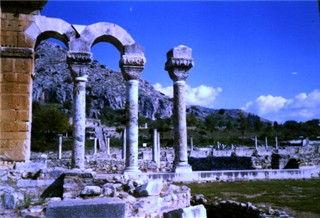
Ruins at Phillipi

(Julius Caesar Act V,Scene II from the Julius Caesar Workbook by Xavier Pinto published by Morning Star.Suitable for students of ICSE schools of class X.If you have a query please post a comment below)

I(i)Where does this scene take place? What is meant by these bills? What is referred to as “the legions on the other side”?
This scene takes place on the battle-field of Philippi. Bills refers to the message that Messala has to deliver to Cassius asking Cassius to attack Octavius. The legions on the other side is the army of Octavius and Anthony.

I(ii) What instructions does Brutus give? To whom are these instructions given.
Brutus gives instructions that Cassius must immediately attack the troops of Octavius. These instructions are given to Cassius via Messala.

I(iii) Brutus hopes to have an advantage at this juncture. What indications has he perceived in this regards.
The indication that Brutus has got, which he feels may give him an advantage, is that the troops of Octavius are not enthusiastic at this point and therefore may not fight well.

I(iv) Give the meaning of “sudden push gives them overthrow”
When Brutus says this he means that a sudden attack on the forces of Octavius may defeat them.

I(v)What warning did Octavius give Brutus the previous night? How was the warning taken.
The warning Ocatavius gave the previous night was that he would fight against the Brutus and the other conspirators till either the killed them or got killed. He said that he would not rest till the death of Julius Ceasar was avenged. This warning was taken very lightly by both Brutus and Cassius. They responded by saying that Octavius was only a schoolboy who was not worthy of dying at the hands of Brutus.

I(vi) What change do you notice in the character of Brutus in this scene.?
The change that one can notice in the character of Brutus in this scene is that the seems to be more positive. He notices that the army of the enemy is less than enthusiastic and therefore sees some chance of a victory. He therefore announces his intention of immediately attacking the army of the enemy.

Julius Caesar Act V Scene I


Ruins of Sardis

(Julius Caesar Act V,Scene I taken from the Julius Caesar Workbook for ICSE school students in India. Questions from the Workbook by Xavier Pinto published by Morning Star. If you have a query or need to clarify please post a comment below.)

1(i).Who are they referred to in line one. What warning would they give? From where would they come to Philippi?
“They” referred to in line one is a reference to Brutus and Cassius and their armies. The warning that they would give means that the armies of Brutus and Cassius want to declare their intention to attacking Octavius and Anthony’s armies in Philippi rather than wait for the armies of Octavius and Anthony to reach Sardis. They would come to Philippi from Sardis.

I(ii) Give the meaning of:
(a)Answering before we do demand of them.
Octavius says that the armies of Brutus and Cassius want to launch the attack even before they are challenged by the armies of Octavius and Anthony.
(b)I am in their bosoms
Anthony say this. The means that he know how the minds of Brutus and Cassius are thinking of when they plan to attack the armies of Anthony and Octavius without waiting for them to reach Sardis.

I(iii) Whose military strategy has dictated that the battle should take place at Philippi? What had Brutus argued regarding this strategy?
Brutus’s military strategy dictated that the battle should take place at Philippi. Brutus’s arguments for meeting the enemy at Phillipi, rather than wait from them in Sardis,are as under:
•Brutus said that the people between Sardis and Philippi were now compelled to be friendly to the armies of Brutus and Cassius. However, if the army of Octavius and Anthony reached Sardis the people would turn against Brutus and Cassius.
•If the people of Sardis turned their supported Octavius and Anthony then their army would get stronger and refreshed through the help that they received from the people. Therefore, meeting the army of the enemy in Philippi would deprive them of the help of the local people.
•Brutus also said that their fortunes were now good and therefore they must attack the enemy when the tides are in their favour rather than when the tide turns against them.

I(iv) What opposition did Brutus meet against this strategy?
The arguments that Cassius gave against this strategy to march to Philippi was that the army of the enemy will be tired after their march into Sardis. While the armies of Brutus and Cassius would be fully rested and will therefore be in a better position to take on the enemy.

I(v) What did Octavius hope that the enemy would do? What according to him is the intention of the enemy?
Octavius had hoped that the enemy would stay at Sardis awaiting for the armies of Octavius and Anthony to reach there. According to him the intention of the enemy is to attack them in Phillipi without waiting for them to reach Sardis.

I(vi)What according to Anthony is the planning of the enemy? Why does Anthony feel so confident that he knows what the enemy intnds to show?
According to Anthony the planning of the enemy is to attack them in Phillipi only to show the enemy that they have a courageous and confident army. However, according to Anthony the real situation is that the enemy is weak and the plans to attack them in Phillipi to trick the enemy into believing that they are strong and confident.

I(vii) What message I brought to Octavius and Anthony by the messenger? How do these two leaders react to this message?
The message that is broutht to Octavius and Anthony is that the enemy is approaching with a red flag which signifies battle. The two leaders react to this by deciding among themselves how they must attack the enemy. This also leads to a quarrel between Anthony and Octavious and who must attack on which side.

II(i) Who is the tongue that Cassius speaks of? Give the substance of what the tongue had said which so offended Cassius.
The tongue that Cassius speaks of is the way Anthony insulted Brutus. Anthony said that Brutus and Cassius had flattered and smiled at Caesar and bowed before him like slaves, kissed his feet to deceive Caesar and then attacked from behind to kill Caesar.

II(ii) Give a brief explanation of the earlier episode that Cassius is referring to when he reminds Brutus that that he himself has to thank for the present situation.
The earlier episode that Cassius is referring to is when Brutus allowed Anthony to address the citizens of Rome after the death of Julius Caesar. It was this speech of Anthony that turned the tide against Brutus and the conspirators. Cassius means that if Brutus had not allowed Anthony to speak, they would not have been facing this troublesome situation.

II(iii) Give the comments made by Cassius, in this next speech, when he scornfully describes Octavius.
Cassius says that Octativus was a silly schoolboy not worthy of dying at the hands of Brutus. He also scorned Octavius’s alliance with Anthony who he described as someone who was interested in wearing masks at parties and who loved noisy merrymaking.

II(iv) What does Octavius means by the cause? State in your own words the meaning of the last two lines of the passage – “ or till another… Caesar…sword of the traitors”.
When Octavius say “come to the cause” he asks Cassius to come to the point and not aruge unnecessarily. The meaning of the last two lines “ or till ……” means that Octavius would fight the traitors like Brutus and Cassius either till he killed all traitors or was killed by the traitors.

II(v) Was Octavius successful in this task of vengeance? How does the play end.
Octavius was successful in this task of vengeance. He was successful in killing Brutus, Cassius and some of the other traitors. The play ends with the death of Brutus. It also ends in a reconciliation between the enemies. Octavius offers service to all those who served Brutus.He takes Strato into his household. Anthony praises Brutus as “the noblest Roman of them all”.The play ends with a feeling that Brutus was victorious even in defeat.

III(i) In this extract Cassius narrates something he has seen. What is it? Did he believe in the significance of such things earlier in his life? Why?
In this extract Cassius narrates that on the way from Sardis two eagles followed them feeding from the soldiers hand. However, on reaching Philippi, the eagles vanished and ravens, crows and kites took their place. Cassius says that he did not believe in the significance of these things earlier in this life as he believed in the philosophy of Epicurus and therefore did not believe in omens.

III(ii) Give the meaning of “As we were sickly prey : their shadows seem/A canopy most fatal” What do these line signify.
Cassisus says this. On the way to Sardis a few eagles had perched on this army’s cavalcade. This he interpreted as a good omen. However, upon reaching Sardis the eagles few away and crows, ravens and kites started hovering over his army. His Cassius has described in the lines above. He say that these crows, ravens, kits looked down upon them as if they were the birds prey, about to die. He says that the shadow of the birds cast a shadow of death over the armies of Cassius and Brutus.

III(iii)What did Cassius see on the previous day and on that particular morning? What do these signs signify.
On the previous day Cassius saw some Eagles hovering on the armies of Brutus and Cassius. This Cassius interprets as a good omen. However, on that particular morning the Eagles flew away and Kites, Crows and Ravens started hovering over their armies. This he interpreted as a bad omen indicating their defeat in the battle with Octavius.

III(iv) How can you conclude from what Cassius says, a little later, that he was prepared for a possible defeat.
We can conclude that Cassius was prepared for a possible defeat because he interprets the appearance of crows, ravens and kites as divine symbols of defeat. Even a little later he discusses with Brutus about the possibility of their death in the imminent battle.

III(v)How does Brutus console him?
Brutus consoles him by saying that their destiny has already been fixed by the Gods. He tells Cassius that they must suffer pain bravely without complaining.

IV(i) What has Brutus just said that makes Cassius say the words given in the extract? Which Roman practice is referred to in Cassius’ speech?
Brutus had just said that it is cowardly to commit suicide and that he would not commit suicide. He says that their destiny has already been fixed by the Gods. The Roman practice of parading prisoners thru the streets of Rome is referred to in Cassius’s speech.

IV(ii) State briefly to what extent Brutus bears a great mind.
We can say that Brutus bears a great mind because even when defeat is staring him in the face he does not loose his equanimity (cool) . Even when he is under great stress, he calmly advices Cassius that their destiny is already decided by the Gods. He says it is not correct to commit suicide in order to avoid the war. He says his final goodbye to Cassius saying that if this is their last meeting, they must part in the right spirit.

IV(iii) What began on the ides of March? How will the words of Brutus be prophetic.
The thought of killing Caesar originated with the prophesy of the soothsayer who said that Caesar must be careful about the ides of March. The words of Brutus will be prophetic because the told Cassius that he would never allow himself to be captured and be paraded through the streets of Rome. His words turned out to be prophetic because he killed himself before he could be captured by the enemy.

IV(iv) Do Cassius and Brutus meet again.?
No Cassius and Brutus do not meet again as both Cassius and Brutus give up their lives during the course of the battle.

IV(v) Brutus and Cassius are affected by the latest events. This makes them act in a different way than their normal behaviour. Give one incident to illustrate this.
Brutus had said earlier that it was wrong to commit suicide and that he would not commit suicide if he was captured. However, even before he was captured he committed suicide. Cassius was not a believer of omens as he followed Epicurus. However, so affected was he by the events that he believed that the crows,vultures and kites that hovered over his army was a bad omen.

Other Questions
Q.Who was Pompey? Why is he referred to in this extract?
A.Pompey was the son-in-law of Julius Caesar who was also an enemy of Julius Caesar. Cassius refers to Pompey because he says that like Pompey was forced to fight Julius Caesar he too was being forced into this battle.

Q.What is Cassius compelled to do? Who has compelled him? How? What would be the outcome of the decision which he is compelled to take.
A.Cassius is forced to go into battle even though he is not very willing to do so. His destiny has compelled to take part in the battle in which he may not survive. The outcome of the decision that he is compelled to take could be his death in the battlefield.

Q.Who is Epicurus? What was his view? If Cassius held the viewpoint of Epicurus, what makes him now to change his mind.
A.Epicurus was a Greek Philosopher. His view was that one should not believe in omens and signs as they did not have any significance in life. Cassius believed in the philosophy of Epicurus and did not believe in omens. However, now Cassius was depressed. He felt that defeat was the only possibility now and therefore he viewed the appearances of crows, kites and ravens as bad omen. So depressed was Cassius that he gave up his belief in Epicurean philosophy.

Q.Give the meaning of “ and partly credit things that do presage.
A.This indicates that the turn of events lead Cassius to believe in omens. Normally, Cassius believed in the philosophy of Epicurus which did not pay any credence to omens.

Q.Comment briefly on the uncertainty which Cassius feels about the outcome of the battle that day. How do Brutus and Cassius wish each other farewell at the end of the scene.
A.Before the battle, Cassius is a very worried man. His instinct tell him that defeat is in store for him. He is so uncertain that he interprets the appearance of crows, kites and ravens as an inauspicious omen. He tells Messala that he is being forced into this battle against his wishes. Brutus and Cassius wish each other farewell before the battle. While they wish that they live up to old age, they acknowledge that this may be the last time they are meeting. Brutus tell Cassius that suicide is not the way out of the ensuing suffering that they may face. They must face the suffering bravely. They part just before the battle by saying that if they do not meet again, they would at-least have the satisfaction of knowing that they parted cheerfully.