Sunday, November 23, 2008

Certified Samosas

I was shocked to see Lokesh wolfing down samosas and patties catered by the Indian Railways. His gastronomic preferences were well known - hygienic and vegetarian. He skipped food when he felt the quality was not upto the mark.He was known to consume soft drinks straight from the bottle since he was suspicious of the cleanliness of the straw. He washed the surface of soft drink cans before opening them. He would quote from www.breakthechain.org/ exclusives/ratcans.html that these cans were stored unhygienically and could lead to contracting to the deadly hanta virus transmitted by rat urine.

HACCP certified food being served on the Shatabdi Express


At home, all fruits and vegetables went through a Potassium Permanganate wash prior to use. He said that Cauliflower was often infected with tissue invading larval forms of the pork tapeworm "Taenia Solium". Cauliflower, therefore was taboo. I have even caught him washing bananas and oranges which are packaged by nature.He was upset with the order of the Railway Ministry to move from Styrofoam cups to earthenware cups.On railway journeys, which were frequent, Lokesh would eschew all food except the tetra packed juice and eclairs. When in doubt, he said, eat the humble banana - after washing.


On market visits, he insisted on eating only at McDonald's, though he hated burgers. He said that this was the only place where you got micro-biologically tested food. According to him, toilet water specification at MacDonald's are better that the Government specification for drinking water. He always said hygiene was important, taste and choice were not.

It, therefore, took me by surprise when I saw him gobbling down the stuff served on the train.When I questioned him about this, in-between samosa bites, he just pointed out to the words HACCP printed on the samosa wrapper.I just didn't get it. It only looked suspiciously similar to CCCP (the old Union of Soviet Socialist Republics).

As Lokesh gobbled and the train wobbled at high speeds, he explained. "HACCP - you pronounce it as "hasup" - is for Hazard Analysis and Critical Control Points. HACCP certification ensures that the vendor has identified Critical Control Points where hazards might occur. It ensures that monitoring procedures are instituted to ensure that safety lapses do not occur, and if they do they do not go uncorrected.So, from the time flour is received to the time finished samosas are delivered on the train, steps to check quality and prevent contamination are in place."

He continued with great enthusiasm. "This even includes ensuring that those who cook and serve wash their hands. Human hands - so important in many stages of food processing - are fertile breeding ground for bacteria, viruses and a host of other organisms, making them a prominent, yet often neglected, critical control point. A careless swipe across the face, an incautious trip to the restroom and billions of contaminants could be released into the processing system." The zest with which he went gaga over the Indian Railways HACCP certification got me wondering. Whenever his family went out for a meal he would now perhaps recommend they dine at the Railway Food Plaza on platform 4, with sterilized Styrofoam cups carried from home!

For more on this,click this link.

Sunday, November 16, 2008

Macbeth - Act II - Scene IV

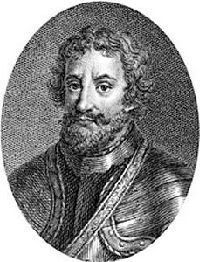
Macbeth


(Question taken from the Indispensable Work-Book on Shakespeare's Macbeth by Usha Nagpal published by National Publishing House. Suitable for class XI. Only Essay type questions answered here. If you have a doubt post a comment below. Leave your mail id if you need a personal response - else i will post my reply to this blog.)


Q1. Duncan's murder precipitates certain abnormal happening. Discuss with a close reference to the scene.

King Duncan's murder precipitates certain abnormal happenings. The old man says " threescore and ten, but this sore night hath trifled former knowings". The old man had not see such abnormal happenings in his seventy years. The day had turned dark and seemed as dark as night as if the earth was hiding its face. A falcon which was flying very high was attacked and killed by a mouse hunting owl - a very unnatural happening. King Duncan's horses which were docile and well trained had turned wild, they broke away from their stall and ran out and even bit each other. Lennox informed them that the chimney of his house was blown out from the house where he stayed. They could hear lamenting in the air, strange screams could be heard all around.


Thus there were a lot of unnatural happenings before and after king Duncan's murder.


Q2.How were the following persons affected, either in their fortunes or their feeling by the murder of Duncan: Malcolm, Macduff, Banquo, Macbeth, Ross.


The fortunes or feelings of the following persons was affected due to the death of king Duncan. The effect of the murder on their lives is as under:


a)Malcolm: Malcolm was the eldest son of king Duncan. He was anointed as the heir to the throne of Scotland and was proclaimed as the next king of Scotland. However, the murder of king Duncan forces him to flee to England in order to escape death. Thus Malcolm's life was thrown into disarray and difficulty on the death of king Duncan. Later however, Malcolm took help from the king of England to overthrow Macbeth to reclaim Scotland.

b)Macduff: Macduff was a loyalist of king Duncan in the kingdom of Scotland. Upon the death of king Duncan he decides to return to his hometown in Fife - where he was the Thene.

c) Banquo: Banquo was murdered by people who were hired by Macbeth. Banquo death follows the death of king Duncan.

d)Macbeth : Upon the death of king Duncan, Macbeth takes over as the king of Scotland.

e) Ross: When Macbeth becomes king, Ross goes over to England to tell Malcolm about the atrocities of Macbeth. He then joins the joint forces of England and Scotland to attack Macbeth.

Macbeth - Act II - Scene III

The Porter

(Question taken from the Indispensable Work-Book on Shakespeare's Macbeth by Usha Nagpal published by National Publishing House. Suitable for class XI. Only Essay type questions answered here. If you have a doubt post a comment below. Leave your mail id if you need a personal response - else i will post my reply to this blog.)

Q1. Give a vivid account of the porter scene.

The scene starts with the porter. The porter is very drunk after he has been "carousing" at the feast. Although the Porter is rather drunk, the jokes that he makes about keeping Hell's Gate become reality when Macduff discovers the terrible scene in the King's bedroom. He describes himself as the "devil-porter" letting people into "hell". He is really Macbeth's porter letting people into Macbeth's castle and he is calling the castle a type of hell on Earth. The porter describes the types of people who come to hell. He tells us of the farmer who committed because he did not get the profit that he was expecting. He talks of the equivocator who could argue convincingly on both sides but could not convince God to let him into heaven. Then he talks of the tailor who came into hell as he had stolen some cloth. The porter describes various types of people to show that all types of people who commit sin come to hell. He says that hell is very hot - i.e. they would suffer in hell for their mis-deeds. The porter says that so many people come to hell the a gate-keeper would grow old just opening and closing the gates of hell.

This is a good example of dramatic irony as the reader knows what has been going on in the previous scene. Shakespeare uses a lot of dramatic irony in this particular scene. Shakespeare uses sentences such as, "Here's a knocking indeed", "If a man were porter of hell-gate" and "turning the key. Shakespeare uses words related to hell to give the scene a lot more effect. He uses words such as "equivocator", nouns such as "Beelzebub" and phrases such as "have napkins enow about you, here you'll sweat".


Q2. List the dramatic functions of the porter scene.
The porter scene follows Duncan's heinous murder evokes some laughter and brings an element of relief in the play. Although the gatekeeper character brings in some comedy, it also has a deeper significance. This "thoughtful laughter" primarily provides comic relief, but it also contributes to the meaning of the work by comparing the castle of Duncan to the gate of hell.

Macbeth's porter scene functions above all as slapstick comic relief following the slaughter of King Duncan. The gatekeeper reduces the tension built in the previous scenes with his drunken talk. For example, he paints a darkly comic caricature of the suspense that now pervades the Macbeth household by making light of the sudden knocking at the gates that so startled Lady Macbeth. Yet this also serves as a paradox - the parody also furthers the tension by prolonging the time between Duncan's murder and the continuation of the plot. This scene immediately prompts laughter with both the porter's light soliloquy and the heightening of the suspense.
However, the character's drunken talk also gives rise to one of the second act's central theme - the house of Macbeth as the gates of hell. His speech refers to satanic images, and he views himself as Beelzebub's gatekeeper. In this act, Shakespeare sees Macbeth's as the central character of death and corruption, evidenced by the evil plans of its Lady and the bloodthirsty acts of its Master. The porter scene emphasizes the fact that all who enter the castle and stand in the way of Macbeth's ambition might as well have entered hell, as they will certainly find a fiery death within. While this scene elicits laughter, it also contributes to Shakespeare's condemnation of Macbeth's escapades.
Macbeth's porter scene also furthers the drama's structure. The previous deeds in Act II have all transpired in an evil supernatural settings - these shocking murders could not have occurred with Shakespeare's settings. The porter scene, by evoking laughter, serves as a movement from the supernatural world of murder to the more real world.
Shakespeare's porter scene causes "thoughtful laughter" and reduces the high tension.

Q3. Bring out the humour and irony of the Porter scene.
There is humour as well as irony in the porter scene. The irony is that the porter compares his letting in people into the castle as letting people into hell. He compares himself to the gate-keeper of hell. Little does the porter know that the events which had taken place (which he does not know of yet - the murder of king Duncan) makes his comparison very real. The murder of Duncan and his guards had indeed made Macbeth's castle a hell.
The humor comes from soliloquy of the porter. He says "who's there in the name of Beelzebub"?. He compares himself to be the gate-keeper of the devil. He then brings humour by describing the reasons why people come to hell. The farmer came to hell because he killed himself for not making the expected profit from his harvest. The equivocator, who could argue on either sides, came to hell because he betrayed his country. The tailor came to hell because he had stolen some cloth. This shows that all kinds of people go to hell - for offences big and small. He also bring humour by saying " having napkins enow about you, here you will sweat". Thus the dialogues and the descriptions both bring in humor.

Macbeth - Act II, Scene II

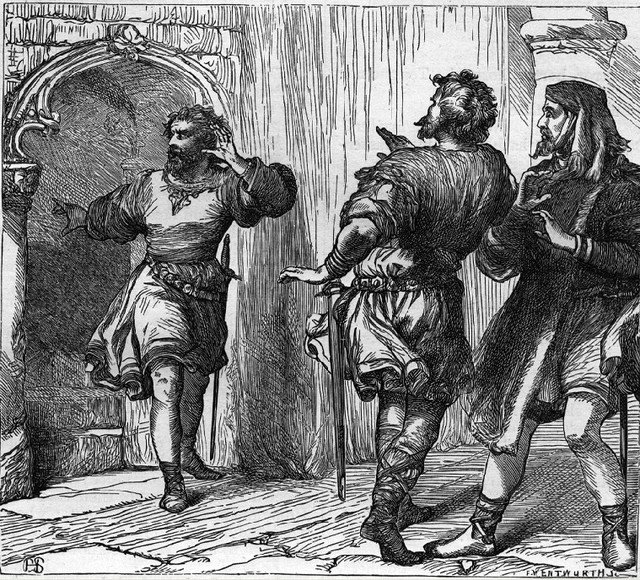
Macbeth enters king Duncan's room for the murder


(Question taken from the Indispensable Work-Book on Shakespeare's Macbeth by Usha Nagpal published by National Publishing House. Suitable for class XI. Only Essay type questions answered here. If you have a doubt post a comment below. Leave your mail id if you need a personal response - else i will post my reply to this blog.)

Q.Compare Macbeth and Lady Macbeth after Duncan's murder. Do they change later on? Justify your answers from the play.


Even before the murder, Macbeth was unsure if he was doing the right thing by murdering king Duncan. However, it was lady Macbeth who forced the issue and ensured that Macbeth carried out the murder.


After the murder, Macbeth is distraught. He is afraid the consequences of having committed the murder. However, lady Macbeth is composed and is in command of the situation. She tells Macbeth " Why worthy Thane do you unbend your noble strength". While Macbeth is nervous after committing the murder, lady Macbeth tell Macbeth to put the instrument back at the scene of the crime. When Macbeth is hesitant she herself does this job and smears blood on the guards of Duncan. Macbeth was completely shaken up by his act. He said " every noise terrifies me". He wondered whether he could ever wash the blood stains from his hands. He is repentant after the murder. When Macduff and Lennox knock at the castle gates, he secretly hopes that this loud noise wakes up the dead king Duncan. Macbeth had difficulty in pretending to be unaware of Duncan's murder. However, Lady Macbeth is in complete charge of herself. She even asks Macduff " What's the business, that such a hideous trumpet calls to parley" (why is there so much commotion). She expresses false shock on being told by Macduff of the death of king Duncan. Later, she pretends to faint on hearing about the death of king Duncan.


Macbeth is repentant about the crime,after having committed it. We know this when he says " Wake Duncan with thy knocking". He wishes that Duncan would wake-up to the knocking at the castle gate. However, Lady Macbeth is un-repentant. She says " I am ashamed to wear a heart so white" (I am ashamed that you are so fearful).


So we can say that while Macbeth wishes he had not committed the crime, lady Macbeth was unrepentant.


Macbeth - Act II Scene I

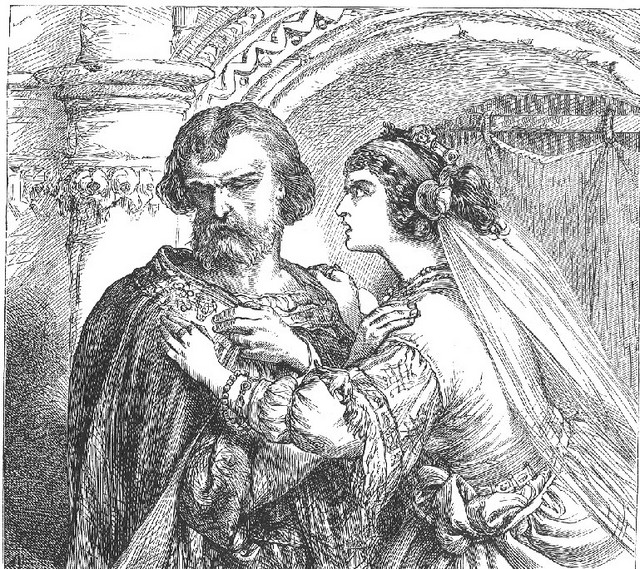
Macbeth and Lady Macbeth


(Questions taken from the Indispensable Work-Book on Shakespeare's Macbeth by Usha Nagpal published by National Publishing House. Suitable for class XI. Only Essay type questions answered here. If you have a doubt post a comment below. Leave your mail id if you need a personal response - else i will post my reply to this blog.)
Q1. Compare the state of mind of Macbeth to that of Banquo on the night of Duncan's murder.
On the night of king Duncan's murder, Banquo was happy,content and peaceful because he was unaware of the plot to kill king Duncan. However, Macbeth was in an agitated state of mind. This was because he was about to carry out the plan of murder. Banquo was in his normal frame of mind but Macbeth was very guarded in his speech. When Banquo said " I dreamt last night of the three weird sisters; to you they have show'd some truth" - Macbeth replied that " I think not of them". Macbeth uttered a lie. He was all the time thinking of the three sisters and their predictions and had planned to kill king Duncan taking guidance from their predictions that he would be the king of Scotland.
On that night Banquo was at peace with himself after having been played a vital role in the victory of king Duncan's army over the enemies. Even though Macbeth had played a more important role in the victory of king Duncan's army -his mind was turbulent because of the murder that he had planned. He was so stressed that he started hallucinating. He saw a dagger where there was none. He saw blood stains on this dagger. He was overwhelmed by the nature of the job which lay ahead - i.e. the killing of king Duncan.
While Banquo had a good night's rest - the night tormented Macbeth. When he was about to murder king Duncan even words failed him. He was not even able to say "Amen" when Duncan in his sleep said "God Bless Us". He was so scared that every noise terrified him. Even a knocking on the door terrified him. While all this was happening to Duncan, Banquo was fast asleep. Macbeth did not sleep all night - he did not even go to bed. Yet, he had to pretend to have gone to sleep - by wearing his night-gown - when somebody started knocking on the castle door. When Macduff came the next morning, Macbeth had to pretend that he slept well the previous night and had to take Macduff to king Duncan's room as if nothing had happened. When Macduff broke the news of king Duncan's death, Macbeth had to react with false shock and false grief. However, Banquo reacted in genuine grief when he heard of the murder.
Thus, Banquo and Macbeth had completely different states of mind on the night of the murder of king Duncan.

Q2.Critically analyse Macbeth's soliloquy in this scene. What light does it throw on his character? Just before the murder, Macbeth was very stressed. He was hallucinating about a blood stained dagger. He imagined a dagger with its handle turned towards him - as if inviting him to pick it up and kill king Duncan. His senses were playing a trick on him.This illustrates that he was not in control of himself. He kept talking to himself to relieve himself of his stress. He compared the deed he was about to commit with with that Hecate' (mistress of witchcraft - who used the dead for their sacrifices) offerings. He also compared the deed that he was about to commit with that of Tarquin's crimes against innocent women.
From this soliloquy, we come to know of the following elements of his character:
a) That he was not very keen or comfortable with carrying out the act of the murder of king Duncan.
b)That he was well educated. His conversation and the use of terms like "Hecate" and "Tarquin" indicates that he was well read.
c) That he was considerate even to his servants. This can be judged from the way he tells his servant to go to sleep after tell lady Macbeth to arrange for his drink.
d) A seasoned murder would not have so many self-doubts before commiting the crime.From this soliloquy it is clear that the act Macbeth was about to commit was a temporary aberraton in his behaviour.
e) This solioquy also tells us that he behaved well with his wife. He asked the servant to tell lady Macbeth to "ring the bell when my drink is ready". Had he been inconsiderate, he would have either asked lady Macbeth to get the drink or would have asked the servant to get it for him.


Wednesday, October 29, 2008

Julius Caesar - Act II, Scene II


(Julius Caesar - Act II, Scene II. Questions taken from Julius Caesar Workbook for ICSE by Xavier Pinto, published by Morning Star. Suitable for students of class IX and X. If you have a query, drop a comment in the comment box at the end of this post. Please leave your mail id if you need a personal response - else if will post my reply in the blog.)


i. In what mood does Calphurnia speak to Caesar? Why does she warn him? When earlier had he been warned of this day?
Calphurnia speaks to Caesar in a very frightened and disturbed framed mind. Calphurnia had cried out in her sleep the previous night that Caesar was being murdered. Now, she begs him not to go out of the Palace at all. She warns him because she feels that there are too many omens which indicate that something is about to go wrong. She tells Caesar that a lioness had given birth on the streets. Graves had opened up to give up their corpses. Clouds had rained blood on the Capitol. Horses neighing and dying men and groaning were, according to Calphurnia, indicators of something terrible to happen. Caesar had been earlier warned of this day during the feast of Lupercal. A soothsayer had warned Caesar to be careful about the Ides of March.

ii. What has Caesar noticed this is about the night? What did he ask his servant to do then? Why?
Caesar had noticed that the previous night was not a regular peaceful night. He had noticed that the omens that night did not appear to portend well for the future. He, therefore, asked his servant go to the priests to make them give a sacrifice immediately and get him their opinion on the result this sacrifice. He wanted to know whether the sacrifice indicated whether the omens were good or bad.
He wanted the opinion of the priests because he was not very sure about interpreting the omens himself.


iii. Caesar says: "Caesar shall forth." On what are Calphurnia's fears based? State two unusual things which she has heard to have happened.
Calphurnia's fears are based on her dreams the previous night. The previous night Calphurnia dreamt that Caesar was being murdered. It was also based on the very frightening omens that people had been witnessing since the previous evening. The two unusual things that she had heard to have happened were of the lioness giving birth on the streets and of graves opening up and giving up the corpses in it.

iv. What does Caesar say later about cowards? What does he say in the extract to show that he is not threatened?
Caesar says that cowards die many times in their imagination even before their actual death. However, brave men experience death only once. In order to show that he is not threatened, he tells Calphurnia that things looked threatening only because they looked only at his back. He also tells Calphurnia that these threats would no longer look formidable once they came face to face with him. He also tells Calphurnia that danger knows very well that Caesar was more dangerous than danger itself. Caesar tells Calphurnia that both the danger and Caesar are lions born on the same day and he was the more dangerous of the two. He tells Calphurnia that to stay home would be like behaving like an animal without a heart.

v. What aspect of the character of Calphurnia as well as of Caesar is hinted at the extract.
From the extract it is apparent that Calphurnia is meek and mild-mannered. She is superstitious and is influenced significantly by omens which she believes portends forthcoming events. She believes that one should pay heed to omens for one's own good. However, Julius Caesar does not believe superstitions, omens and other similar practices. Julius Caesar is a very confident person he depends on his abilities to tackle things as they come. Julius Caesar fears nothing. He feels that there is no situation or difficulty which he cannot tackle with his skill and power.

2.
i. What is meant by, "I never stood on ceremonies"? What is Caesar's normal opinion on such things?
Calphurnia says that "I never stood on ceremonies". By this she meant that she normally did not believe in omens was not superstitious in nature. She, however, says that the omens this time were so scary that it was not wise to discard the meaning of these omens. Caesar's normal opinion on such things was one of disdain. Caesar had only marginal belief in superstition. Even if he believed the superstition he would not turn his back to event just because the omen did not portend well for him. Julius Caesar was that brave man he would go and face the event even if the signs did not bode well for him.

ii. Mentioned any three other signs enumerated by Calphurnia in her speech. Why does she narrate such sights at this time?
The three other signs enumerated by Calphurnia in her speech are about violet soldiers in flames fighting on the clouds in perfect battle formation. Clouds raining blood on the capital the neighing of horses. She narrates all these sights to Julius Caesar at this time because she thinks that by telling Caesar about these unnatural happenings would make him reconsider his decision about going out on that day.

iii. What does Calphurnia's speech reveal about her character?
From the extract it is apparent that Calphurnia meek and mild-mannered. She is superstitious influenced significantly by omens which she believes portends forthcoming events. She believes that one should pay heed to omens for one's own good. Calphurnia speech also reveals that she genuinely cared about the well-being of Julius Caesar.

iv. What is Caesar's reaction to Calphurnia fears? What does he decide to do?
Caesar says that cowards die many times in their imagination even before their actual death. However, brave men experience death only once. In order to show that he is not threatened he tells Calphurnia that things looked threatening only because they looked at his back. He also tells Calphurnia that these threats would no longer look formidable once they came face to face with him. He also tells Calphurnia that danger knows very well that Caesar was more dangerous than danger itself. Caesar tells Calphurnia that both danger and Caesar were lions born on the same day and it was he who was the more dangerous of the two. He tells Calphurnia that to stay home would be like behaving like an animal without a heart. He therefore decides to go out and face the events.

v. What does Caesar a little later do to indicate that death is inevitable?
Caesar says that death is inevitable. He also says that cowards die several times even before their actual death. He says that death will come its appointed time. He also says that danger knows very well that he himself is more dangerous than danger. In order to prove that he was not afraid of any danger he decides go to the Capitol against the wishes of Calphurnia.

3.
i. Where are Calphurnia and Caesar at this moment?
Calphurnia and Julius Caesar are their palace at this moment.

ii. State two reasons offered by Calphurnia for wanting Caesar to stay at home.
The first reason offered by Calphurnia for wanting Caesar to stay was that all omens indicated that something frightful was about happen. The second reason that Calphurnia offered for wanting Caesar to stay at home was that his wisdom was eaten up by his self-confidence. Calphurnia also told Caesar , on her knees, to allow her to have her say in this matter.

iii. Bring out three arguments Decius puts forward to make Caesar change his mind.
The three arguments that Decius put forward to make Julius Caesar change his mind are :
a) that senators would laugh at him if he told them that Caesar would not be going to the Capitol, without assigning any reasons.
b) the second reason that Decius gave was that Calphurnia had interpreted her dream incorrectly. According to Decius, the interpretation Calphurnia's dream was that Rome would receive a new life from Julius Caesar.
c) the third reason that Decius gave Julius Caesar was that the Senate had decided to give the crown on that day. Decius felt that if Julius Caesar did not accept the crown the same day, the senators could even change their mind till Caesar's wife had better dreams.

iv. Explain clearly in your own words the meaning of "your wisdom is consumed in confidence". Was Calphurnia correct in her judgement of her husband? Why?
The meaning of "your wisdom is consumed in confidence" meant that Julius Caesar was making an error of judgement based on the confidence of his abilities tackle things they came. Calphurnia was absolutely correct in her judgement of her husband. We can say that Calphurnia was correct in her judgement her husband because of the events that followed. According to Calphurnia all the omens indicated that something evil was about to befall Julius Caesar. Caesar, of course, did not subscribe to these views fully. However, the assassination of Julius Caesar and the subsequent civil war in the country indicated that all these would not have transpired if Julius Caesar had listened to the pleas of Calphurnia.

v.What is revealed of Calphurnia's character in the above words? How is she contrasted with Portia who appears in the scene?
From these lines we can say that Calphurnia was genuinely concerned with the well-being her husband. We can say that Calphurnia was a good interpreter of omens.She could correctly decipher what was likely to happen on the basis of omens. From the lines it is also very clear that Calphurnia was a very persuasive person. Caesar was never an easy man to convince. Yet, Calphurnia managed to convince to stay back in the palace on the 15th of March - till Decius appeared on the scene. From these lines it is also apparent that under normal circumstances she had no say in the plans of Julius Caesar. It was only under special circumstances like these that she was able to exert some authority.
If we compare Calphurnia's character with Portia we find that Portia was a more forceful and a more determined woman. Portia demanded equality with Brutus. Portia even demonstrated to Brutus liability to withstand pain by cutting off a piece of flesh from her thigh letting the wound bleed without any treatment. However, both women were equally concerned with the decision-making and abilities their husbands. They knew that their husbands did not always take the right decision under stress.

4.
i. Where other speakers at this moment? What day is this?
The speakers are at Julius Caesar's palace this moment. This day is the 15th of March i.e. the Ides of March.


ii. What does Calphurnia dream? How did she interpret her dream? How does Decius interpret her dream?
Calphurnia dreamt ,the previous night, that the statue of Julius Caesar sprouted blood at a hundred places and that many strong and vigorous Romans came smiling and bathed their hands in it. She interpreted these as warnings and omens of disasters which were about to happen. However, Decius told Julius Caesar that this interpretation her dream was not correct. According to Decius, the sprouts of blood indicated that Rome would receive a new life from Caesar and that the Romans would crowd around Julius Caesar for colours to be added their coats of arms, objects of reverence, and badges of service.

iii. What other reasons did Calphurnia state for not wanting Caesar to go to the Senate?
The other reason that Calphurnia is stated for not wanting Caesar to go to the Senate was that according to her his wisdom was eaten up by his self-confidence. According to Calphurnia,Caesar was not acting rationally taking into account whatever the situation warranted.


iv. What other statements did Decius make to convince Caesar that he should attend the Senate. How was it that Decius has come on this scene at this time?
The Decius first tells Julius Caesar that Calphurnia had interpreted her dream incorrectly. Decius tells Julius Caesar that her dream indicated that he would give Rome a new lease of life. Roman life would prosper under him. Decius also tells Julius Caesar that the Senate had decided to give the crown that day. If Caesar did not go to the Capitol to accept the crown it was even possible that the Senate may even decide not to give the crown to Julius Caesar. Decius had come to this scene in pre-planned manner. It was decided earlier, when they had met at the residence of Brutus, that should Caesar decide not to go to the Capitol, on that day, for reasons of superstition then Decius would talk Caesar into making the trip to the Capitol.
v. What is your opinion of Caesar at this point in the play? Express your feelings for him when he's assassinated?
In my opinion, Caesar has been a very unreasonable person at this point of the play. It is important for the ruler of a country to heed to the advice of well-wishers. In this case, Julius Caesar was originally warned by the soothsayer to be careful of the ides of March. Subsequently, his wife Calphurnia beseeched him not to go out because the omens were very bad indicating that something was amiss. Not only that, Julius Caesar's own sacrifice animals by his priests indicated that he should not venture out on that day. However, Julius Caesar discarded all advice from well-wishers proceeded the capital for his coronation.
My feelings for him, on his assassination, are mixed. I feel sorry that he was assassinated for he may have proved to be a good ruler for his country. At the same time, I also feel that the deserved the fate that he met with. No ruler of any country can hope to govern well if he continuously ignores well-intentioned advice from people who love the ruler. In this case, he ignored well-intentioned advice paid the price for ignoring important advice. I therefore feel that also deserved the fate that he met with.

5.

i. What had Decius assured that the Senate was proposing to do on that particular day?
Decius had assured Caesar that the Senate was proposing to offer the crown on that particular day. Decius also told Caesar that in the event that he did not go to the capital the Senate could even change its mind about offering the crown to Julius Caesar.


ii. When was a similar thing already offered and what was the reaction of Caesar that time?
The crown was earlier offered to Julius Caesar during the feast of Lupercal. However, at this point of time he declined to take the crown though the crown was offered to him. Julius Caesar declined to accept the crown at this point of time because he wanted a bigger consensus to be built within the people of the country about his coronation before he accepted the crown.

iii. What interpretation had Decius offered to Calphurnia's dream what was his motive?
The interpretation that Decius had offered about Calphurnia's dream was that under the rule of Julius Caesar role would prosper. Decius said that the interpretation of blood gushing from his statue indicated that would infuse new life in Rome and that the people of Rome would thrive under his rulership.


iv. Earlier in the play, Caesar had expressed once to Antony and once to Calphurnia, other thoughts on the topic of fear. Described as closely as you can, anyone of the things that he says about fear.
Julius Caesar's had said that the danger knows very well that he was more dangerous than danger itself. He said that both danger and he were like lions born on the same day it was he who was the elder and the more terrible of the two.

v. Explain in your own words the meaning of the phrase "it were a mock/to be rendered". What is revealed by Decius character the passage.
The meaning of this phase is that if the Senate came to know that Julius Caesar did not turn up to accept the crown on account of Calphurnia's bad dreams, then the Senate could well joke that they should wait to give Julius Caesar the crown till such time his wife had better dreams.
These words revealed Decius' sinister character. Decius is a very skillful orator who can turn a situation with the use of his words. The conspirators have made very good use of Decius's skills b by bringing him the scene at the point where Caesar had almost decided not to go to the Capitol after having been warned by many well-wishers. However, Decius used his interpretation of Calphurnia's dreams to convey to Caesar that he would miss the chance of his life if he did not go to the Capitol on that day.

Tuesday, October 28, 2008

Blackberry - The call drops when you try to get it repaired


When the trackball on my Blackberry Pearl stopped working, I called up Airtel to book it for service. My experience was as under:
- for the device to be booked for repairs it needs to be dropped off at only the specified Airtel office.

- the cost of repair is Rs.5,600/- irrespective of the nature of the complaint.

- this amount has to be paid either by cheque or demand draft. Cash and credit cards not accepted.

- you get a standby device only if you insist and are persistent about it. If you do not know of this facility - Airtel does not educate you about this facility. The standard time quoted for the repair is two weeks. You can't get them to get it done earlier - no matter what.

- You cannot drop of the device directly to the service center. You have got to give it to the Airtel office who then have to send the device to the service center via the internal courier.

- It is difficult to located the people who are responsible for Blackberry service at the Airtel office. The front office staff are only interested in collecting payment against invoices. Giving information about Blackberry repairs and putting you in touch with the Blackberry team is not what they give any priority. (apparently Wipro provides this service in Bangalore).

- They are not very savvy about transferring data from the device in distress to the standby device. Please carry your laptop with you for the data transfer - at the time of giving the device for repair. Insist on getting the data transferred (if you so desire) else you will be stuck without your address book.

- Be nice to them, if you want your work done.They may or may not be nice to you.

Update on 9 November, 2008

I got back my Blackberry back, after repairs, on the 5th November as promised. The device looks like new. I don't know if this is a new device or the old one with the face-plate changed. Whatever it is, it works well now - and looks brand new. It was worth the wait and the Rs.5,600 charge.