(Julius Caesar Act III Scene III.Questions taken from the Julius Caesar workbook by Xavier Pinto published by Morning Star.Suitable for class X, ICSE students)
1(i) Cinna was a poet who lived in Rome. His name was the same as that of a conspirator in the group of Brutus. He wandered forth (went out ) even though he did not want to. He felt that a strange power was compelling him to go out. He dreamt that night that he had a feast with Caesar.
1(ii)” Things unluckily charge my fantasy” means that Cinna saw some unlucky omens in his dreams. The ironical thing about this statement is that normally one sees only good things in a fantasy. A fantasy is usually associated with desirable things.
1(iii) Cinna had no desire to go out as he had seen some bad omens in his dreams. This extract shows that people in the Elizabethan age were very superstitious and believed that what they saw in their dream indicated events of the future.
1(iv) The mob asked Cinna questions like :
- are you married or a bachelor?
- What is your name?
- Where are you going?
- Are you Caesars friend or foe?
- Where do you live?
1(v) The mobs reaction to his answers was calm till he told them that his name was Cinna. The moment they learnt that he was Cinna the mood of the mob turned destructive and they decided to kill him immediately. Even after Cinna clarified that he was Cinna the poet and not the Cinna conspirator, the mob did not relent and killed Cinna.
1(vi) Shakespeare has given only a brief description of the actions of a frenzied mob. He has not described the gory (terrible) action of the frenzied mob in detail.
2(i) The mob which is trying to seek out Brutus and the conspirators ask Cinna all the questions. Upon hearing that the name of the person was Cinna – which is also the name of one of the conspirators in Brutus’s group – they become confused and irrational and attack Cinna to kill him.
2(ii) This conclusion is not logical because Cinna had only said in jest “cleverly I am not married” . Cinna did not intend to say or mean that those who marry are fools.
2(iii) The pun intended in the word “ directly” is that the mob wanted Cinna to give them a straight forward answer as well as look at them “directly”in their eyes while answering. Those who look at people in the eyes directly do not lie.
2(iv) It was unfortunate for the man to have Cinna as his name since Cinna was also the name of one of the conspirators and the mob was in a destructive mood and did not care to distinguish the fact that this Cinna was a poet who has no role in the conspiracy. The citizens dealt with him by killing him.
2(v) The scene tell us that a lot of destruction and death was about to follow as a result of the speech of Mark Anthony.
2(vi) The significance of this short scene in the play is that it set the mood and expectation of the reader of what is about to follow. Dramatically, it change the mood of the play from being conspiratorial (planning the killing ) to more action oriented like causing death and destruction.
(Useful web resource on Julius Caesar : http://www.drbilllong.com/ShakeJC/JuliusCaesar.html)
Sunday, August 17, 2008


Julius Caesar - Act III,Scene II
(Julius Caesar Act III,Scene II. Question taken from the Julius Caesar workbook by Xavier Pinto, published by Morning Star.Suitable for ICSE students of class X)
1(i) Brutus is at the marketplace. He is about to address the citizen of Rome to give an explanation to them about why he and his associates killed Julius Caesar. He asked the people assembled there to be patient so that they can listen to him fully before making any judgement on the act of killing Julius Caesar. This speech is made on after the killing of Julius Caesar just before his funeral.
1(ii) Honour was important for Brutus for he considered himself to be fair and impartial. He also considered himself to act in the best interests of the citizens of Rome. In order to be honourable, Brutus allowed Mark Anthony to address the citizens of Rome at the funeral of Caesar. Had he not been honourable he would not have allowed Mark Anthony this privilege to addressing the citizens since he had been warned by Cassius that Mark Anthony speech could cause trouble for the conspirators. His commitment to honour lead Brutus to a crisis because after hearing the speech of Mark Anthony, the citizens of Rome turned against Brutus and his fellow conspirators.
1(iii) “Hear me for my cause” His cause was the prevention of the enslavement of the people of Rome in the hands of Julius Caesar. Brutus’s motives were genuine. We can say this for the following reason:
- Brutus truly believed that Caesar would become a tyrant once he was crowned as the Emperor of Rome.
- Brutus had no personal motive in the killing of Julius Caesar. That is why he did not object when Mark Anthony spoke of Caesar in glowing terms, after he was killed.
- Brutus was respectful of all people. We can note from his interaction, with his wife Portia, that he had a lot of respect for women, in a society which did not respect women too much.
- Brutus had no personal enemity with Caesar. In fact he had a lot of respect for Caesar in many ways.
1(iv) The reaction of the listeners at the beginning of the scene, when Brutus address the audience, is one of agreement with the reasoning given by Brutus for the killing of Julius Caesar. At the end of the scene the reaction of the audience changes completely. From agreement to the killing of Caesar it changes to hate for the conspirators. The change of attitude is a result of the speech of Mark Anthony. He convinced the audience that Caesar was neither greedy nor did he lust for power. So convincing was his oratory that the citizens of Rome decided to finish off Brutus and his fellow conspirators.
1(v) “Censure me in your wisdom”. Brutus tell this to the citizens of Rome. He means that, after hearing his reasons for the killing of Caesar if the citizens disagree with reasons they may punish Brutus for the killing. The citizens of Rome passed censure on him. This censure changed the course of action in the play since, Brutus instead of becoming hero for the killing of Caesar, is treated like the villain who wrongly killed Julius Caesar.
2(i) Brutus intended to depart alone because he was convinced that the citizens or Rome were in agreement with the reasons for the killing of Julius Caesar. He did not see any need to stay back to hear Mark Anthony as the did not anticipate any trouble after Mark Anthony speech.
2(ii) This means the Brutus urged the people of Rome to stay back after his speech in order to pay respect to Caesar’s death by spending a little more time with his dead body as well as to stay back to listen to Mark Anthony tribute to Caesar.
2(iii) The explanation that Brutus gave in his speech for the murder of Caesar are as under :
- he said Caesar would have made the citizens of Rome his slaves on becoming the Emperor.
- He said that Caesar was greedy for power.
The reaction of the listeners to this was of complete agreement with the reasoning of Brutus. They agreed with the reasons and the need for the death to Caesar.
2(iv) Anthony was given permission by Brutus, to speak. The conditions under which Anthony was allowed to speak are as under :
• Anthony should not blame Brutus and his friends for the death of Caesar.
• That Anthony should speak from the same pulpit from which Brutus would speak.
• That Anthony should speak only after Brutus had finished speaking.
2(v)Caesars glories that Anthony would refer to in his speech later are:
• He was faithful and fair to his friends.
• He worked hard to fill the fill the government treasury.
• He was not greedy for power. He refused the crown thrice during the feast of Lupercal.
His objective behind the speech is to generate sympathy for Caesar and to turn public opinion against Brutus and his friends.
3(i) As Anthony ascends to the platform to speak the citizens were all praise for Brutus and wanted to carry him to his home, make his statue and make him Caesar. They felt that Caesar was ruthless, greedy and ambitious and that he was rightly killed. They were neutral about Anthony and did not know what to expect from Anthony. They expected Anthony to be anti Brutus.
3(ii) The citizens stayed behind to listed to Anthony only because Brutus had asked them to do so. At the beginning of Anthony speech the citizens were a little suspicious of the intentions of Anthony. However, by the end of Anthony’s speech all the suspicions disappeared and they approved of what Anthony spoke.
3(iii) This means that the good deeds that a person does during his lifetime is not recognized and the wrongs that they do is highlighted.
3(iv) The evil that Caesar did that lives after him are :
• He was considered to be greedy.
• He was considered to be power hungry.
• It was said that he wanted enslave the people of Rome after becoming Emperor.
The two examples of good done by Caesar are:
• He brought prisoners of war with him to Rome so that other nations would pay money to Rome to have them freed.
• He, in his will, had given every citizen of Rome seventy-five drachmas.
3(v) Anthony say “the noble Brutus” because Brutus had completed this speech before Anthony has begun his speech. Brutus’s speech had generated a lot of respect for him and public opinion was in favour of Brutus. In order not to earn the wrath of the audience, Anthony addressed Brutus respectfully as noble Brutus. He uses the term “if it were so” because he did not agree with the assessment of Brutus that Caesar was ambitious. Anthony could not have been frank about his remark since in the beginning of Anthony’s speech the mood of the audience was overwhelmingly in favour of Brutus and against Anthony.
3(vi) I admire Anthony at this juncture because against all odds and in the presence of Brutus and other conspirators he had to generate sympathy for Caesar. The acceptance of the reasoning given by Brutus of the killing of Caesar had make Anthony’s job even more difficult. However, Anthony, without antagonizing Brutus and his men got them to give him a change to address the audience. When he got the chance to address the audience – the gently reminded them of all that Caesar had done for them. He told the audience about Caesar’s will – that Caesar had willed his fortune to the people of Rome. This generated sympathy for Caesar and turn the tide against Brutus and his men.
4(i). The testament refers to the “will” of Caesar. “Commons are the citizens of Rome.
4(ii) The means that once the citizens of Rome realize what Caesar had written in his will they would be ashamed that they did not mourn the death of their leader. Anthony told the Citizens of Rome that if they knew what Caesar had for them in his will they would kiss the dead Caesars wounds dip their napkins in his blood as a mark of respect. They would beg to get a strand of his hair and keep this strand of his hair like a heirloom and pass it on to subsequent generations of their families.
4(iii) Anthony uses hyperbolic expressions like “sacred blood”, kiss dead Caesars wounds” The effect that this language has on the commons is that they are swayed by the oration of Anthony and their mood changes. From support for the killing of Caesar, the mood of the audience changes to sympathy for Caesar and contempt for the conspirators.
4(iv) The two reasons why the commons would dip their napkins in Caesars blood and beg a hair of his are as under :
- because they now viewed Caesars death as a sacrifice and as a result his blood and hair was viewed as holy.
- They would dip their napkin in Caesars blood and beg for his hair as an mark of respect to Caesar and as a sign of atonement for having earlier supported his killing.
Caesars blood was considered holy since the had sacrificed his life for the people of Rome. Sacrificial blood was considered holy then.
4(v) Other than the “will” Anthony showed the audience the cloak that Caesar wore for the first time when he conquered Nervii. He also showed them the dagger that Cassius used to stab Caesar. He pointed out to the Romans how mutilated the body of Caesar had become. This incited the commons because they, upon seeing these thing, now realized that Caesar was killed unfairly.
4(vi) Anthony cleverly played on the emotion of people to make them react as he desired. He began by showing a lot of respect to Brutus and his men as the mood among the audience was one of agreement to what Brutus had done. Later, he cleverly gave examples to the audience of why Caesar was neither greedy, ambitious or that he had any intention to enslave people after becoming Emperor. He told his audience that, after a person’s death, the evil he had done is remembered. Using this as the pretext he reminded the audience of the good that Caesar had done for the welfare of Romans. This influenced the audience in favour of Caesar. He couched his praise for Caesar by saying that he was upset with the death of Caesar therefore was very sentimental. He cleverly asked the audience why they were not mourning for Caesar and if there was something wrong with their sense of judgement. He brought our the issue of Caesars will to show to the people that Caesar was generous and had asked for his fortune to be divided among Romans. These issues generated a lot of sympathy for Caesar and the opinion of the audience shift from hatred for Caesar to sympathy for Caesar.
5(i) The wounds of Caesar are referred to as poor dumb mouths because they are not able to tell the world the brutal manner of Caesars death caused by people who Caesars loved and trusted. Mark Anthony, in order to incite (anger) people told them if he had been Brutus he would have ensure that every wound in Caesar’s body would have been given a tongue to tell the world how Caesar was killed through treachery. Anthony cleverly tell the people, using Brutus as the shield, how they must react to the brutal killing of Caesar.
5(ii) In order to say that there should be mutiny on Caesars death, Anthony cleverly says that if he and Brutus had exchanged places, Brutus would have talked about every wound in Caesar’s body to generate sympathy for Caesar and would have incited the citizens of Rome to revolt against the conspirators.
5(iii) Anthony indirectly says that if he were Brutus, he would have ensured that all wounds in Caesars body would have spoken about the unjust and inhuman manner in which Caesar was killed. The irony of the words in this extract is that he uses Brutus as a shield (saying “ if he were Brutus”) incite the people of Rome to mutiny.
5(iv) The mob leaves the scene in a destructive mood. They leave with sympathy for Caesar and contempt for the conspirators. They decided to loot and burn everything in their path. They decided to burn the conspirators. After the departure of he mob Anthony says the Goddess fortunate is with him and that the Goddess would grant him anything given the mood of the people. The then asks the servant to take him to Octavius.
5(v) At the end of the scene, Anthony decides to go to Caesars place where Octavius and Lepidus are waiting. Brutus and Cassius had to flee Rome in order to escape the fury of the mob.
5(vi)The tactics that Anthony used to make the common people slaves of passion and resentment are :
- Continuously referring to the goodness and greatness of Caesar. This make the Romans believe that Caesar was unfairly killed.
- Not directly criticizing Brutus and his team of conspirators. This leads the Romans to believe that Mark Anthony had no ulterior motives in praising Caesar.
- Constantly referring to the wound on the body of Caesar, thereby creating sympathy for Caesar.
- Referring to the will of Caesar to prove that Caesar was not greedy but wanted good things for the people of Rome and that is the reason why he had willed seventy five drachmas for every citizen of Rome.
1(i) Brutus is at the marketplace. He is about to address the citizen of Rome to give an explanation to them about why he and his associates killed Julius Caesar. He asked the people assembled there to be patient so that they can listen to him fully before making any judgement on the act of killing Julius Caesar. This speech is made on after the killing of Julius Caesar just before his funeral.
1(ii) Honour was important for Brutus for he considered himself to be fair and impartial. He also considered himself to act in the best interests of the citizens of Rome. In order to be honourable, Brutus allowed Mark Anthony to address the citizens of Rome at the funeral of Caesar. Had he not been honourable he would not have allowed Mark Anthony this privilege to addressing the citizens since he had been warned by Cassius that Mark Anthony speech could cause trouble for the conspirators. His commitment to honour lead Brutus to a crisis because after hearing the speech of Mark Anthony, the citizens of Rome turned against Brutus and his fellow conspirators.
1(iii) “Hear me for my cause” His cause was the prevention of the enslavement of the people of Rome in the hands of Julius Caesar. Brutus’s motives were genuine. We can say this for the following reason:
- Brutus truly believed that Caesar would become a tyrant once he was crowned as the Emperor of Rome.
- Brutus had no personal motive in the killing of Julius Caesar. That is why he did not object when Mark Anthony spoke of Caesar in glowing terms, after he was killed.
- Brutus was respectful of all people. We can note from his interaction, with his wife Portia, that he had a lot of respect for women, in a society which did not respect women too much.
- Brutus had no personal enemity with Caesar. In fact he had a lot of respect for Caesar in many ways.
1(iv) The reaction of the listeners at the beginning of the scene, when Brutus address the audience, is one of agreement with the reasoning given by Brutus for the killing of Julius Caesar. At the end of the scene the reaction of the audience changes completely. From agreement to the killing of Caesar it changes to hate for the conspirators. The change of attitude is a result of the speech of Mark Anthony. He convinced the audience that Caesar was neither greedy nor did he lust for power. So convincing was his oratory that the citizens of Rome decided to finish off Brutus and his fellow conspirators.
1(v) “Censure me in your wisdom”. Brutus tell this to the citizens of Rome. He means that, after hearing his reasons for the killing of Caesar if the citizens disagree with reasons they may punish Brutus for the killing. The citizens of Rome passed censure on him. This censure changed the course of action in the play since, Brutus instead of becoming hero for the killing of Caesar, is treated like the villain who wrongly killed Julius Caesar.
2(i) Brutus intended to depart alone because he was convinced that the citizens or Rome were in agreement with the reasons for the killing of Julius Caesar. He did not see any need to stay back to hear Mark Anthony as the did not anticipate any trouble after Mark Anthony speech.
2(ii) This means the Brutus urged the people of Rome to stay back after his speech in order to pay respect to Caesar’s death by spending a little more time with his dead body as well as to stay back to listen to Mark Anthony tribute to Caesar.
2(iii) The explanation that Brutus gave in his speech for the murder of Caesar are as under :
- he said Caesar would have made the citizens of Rome his slaves on becoming the Emperor.
- He said that Caesar was greedy for power.
The reaction of the listeners to this was of complete agreement with the reasoning of Brutus. They agreed with the reasons and the need for the death to Caesar.
2(iv) Anthony was given permission by Brutus, to speak. The conditions under which Anthony was allowed to speak are as under :
• Anthony should not blame Brutus and his friends for the death of Caesar.
• That Anthony should speak from the same pulpit from which Brutus would speak.
• That Anthony should speak only after Brutus had finished speaking.
2(v)Caesars glories that Anthony would refer to in his speech later are:
• He was faithful and fair to his friends.
• He worked hard to fill the fill the government treasury.
• He was not greedy for power. He refused the crown thrice during the feast of Lupercal.
His objective behind the speech is to generate sympathy for Caesar and to turn public opinion against Brutus and his friends.
3(i) As Anthony ascends to the platform to speak the citizens were all praise for Brutus and wanted to carry him to his home, make his statue and make him Caesar. They felt that Caesar was ruthless, greedy and ambitious and that he was rightly killed. They were neutral about Anthony and did not know what to expect from Anthony. They expected Anthony to be anti Brutus.
3(ii) The citizens stayed behind to listed to Anthony only because Brutus had asked them to do so. At the beginning of Anthony speech the citizens were a little suspicious of the intentions of Anthony. However, by the end of Anthony’s speech all the suspicions disappeared and they approved of what Anthony spoke.
3(iii) This means that the good deeds that a person does during his lifetime is not recognized and the wrongs that they do is highlighted.
3(iv) The evil that Caesar did that lives after him are :
• He was considered to be greedy.
• He was considered to be power hungry.
• It was said that he wanted enslave the people of Rome after becoming Emperor.
The two examples of good done by Caesar are:
• He brought prisoners of war with him to Rome so that other nations would pay money to Rome to have them freed.
• He, in his will, had given every citizen of Rome seventy-five drachmas.
3(v) Anthony say “the noble Brutus” because Brutus had completed this speech before Anthony has begun his speech. Brutus’s speech had generated a lot of respect for him and public opinion was in favour of Brutus. In order not to earn the wrath of the audience, Anthony addressed Brutus respectfully as noble Brutus. He uses the term “if it were so” because he did not agree with the assessment of Brutus that Caesar was ambitious. Anthony could not have been frank about his remark since in the beginning of Anthony’s speech the mood of the audience was overwhelmingly in favour of Brutus and against Anthony.
3(vi) I admire Anthony at this juncture because against all odds and in the presence of Brutus and other conspirators he had to generate sympathy for Caesar. The acceptance of the reasoning given by Brutus of the killing of Caesar had make Anthony’s job even more difficult. However, Anthony, without antagonizing Brutus and his men got them to give him a change to address the audience. When he got the chance to address the audience – the gently reminded them of all that Caesar had done for them. He told the audience about Caesar’s will – that Caesar had willed his fortune to the people of Rome. This generated sympathy for Caesar and turn the tide against Brutus and his men.
4(i). The testament refers to the “will” of Caesar. “Commons are the citizens of Rome.
4(ii) The means that once the citizens of Rome realize what Caesar had written in his will they would be ashamed that they did not mourn the death of their leader. Anthony told the Citizens of Rome that if they knew what Caesar had for them in his will they would kiss the dead Caesars wounds dip their napkins in his blood as a mark of respect. They would beg to get a strand of his hair and keep this strand of his hair like a heirloom and pass it on to subsequent generations of their families.
4(iii) Anthony uses hyperbolic expressions like “sacred blood”, kiss dead Caesars wounds” The effect that this language has on the commons is that they are swayed by the oration of Anthony and their mood changes. From support for the killing of Caesar, the mood of the audience changes to sympathy for Caesar and contempt for the conspirators.
4(iv) The two reasons why the commons would dip their napkins in Caesars blood and beg a hair of his are as under :
- because they now viewed Caesars death as a sacrifice and as a result his blood and hair was viewed as holy.
- They would dip their napkin in Caesars blood and beg for his hair as an mark of respect to Caesar and as a sign of atonement for having earlier supported his killing.
Caesars blood was considered holy since the had sacrificed his life for the people of Rome. Sacrificial blood was considered holy then.
4(v) Other than the “will” Anthony showed the audience the cloak that Caesar wore for the first time when he conquered Nervii. He also showed them the dagger that Cassius used to stab Caesar. He pointed out to the Romans how mutilated the body of Caesar had become. This incited the commons because they, upon seeing these thing, now realized that Caesar was killed unfairly.
4(vi) Anthony cleverly played on the emotion of people to make them react as he desired. He began by showing a lot of respect to Brutus and his men as the mood among the audience was one of agreement to what Brutus had done. Later, he cleverly gave examples to the audience of why Caesar was neither greedy, ambitious or that he had any intention to enslave people after becoming Emperor. He told his audience that, after a person’s death, the evil he had done is remembered. Using this as the pretext he reminded the audience of the good that Caesar had done for the welfare of Romans. This influenced the audience in favour of Caesar. He couched his praise for Caesar by saying that he was upset with the death of Caesar therefore was very sentimental. He cleverly asked the audience why they were not mourning for Caesar and if there was something wrong with their sense of judgement. He brought our the issue of Caesars will to show to the people that Caesar was generous and had asked for his fortune to be divided among Romans. These issues generated a lot of sympathy for Caesar and the opinion of the audience shift from hatred for Caesar to sympathy for Caesar.
5(i) The wounds of Caesar are referred to as poor dumb mouths because they are not able to tell the world the brutal manner of Caesars death caused by people who Caesars loved and trusted. Mark Anthony, in order to incite (anger) people told them if he had been Brutus he would have ensure that every wound in Caesar’s body would have been given a tongue to tell the world how Caesar was killed through treachery. Anthony cleverly tell the people, using Brutus as the shield, how they must react to the brutal killing of Caesar.
5(ii) In order to say that there should be mutiny on Caesars death, Anthony cleverly says that if he and Brutus had exchanged places, Brutus would have talked about every wound in Caesar’s body to generate sympathy for Caesar and would have incited the citizens of Rome to revolt against the conspirators.
5(iii) Anthony indirectly says that if he were Brutus, he would have ensured that all wounds in Caesars body would have spoken about the unjust and inhuman manner in which Caesar was killed. The irony of the words in this extract is that he uses Brutus as a shield (saying “ if he were Brutus”) incite the people of Rome to mutiny.
5(iv) The mob leaves the scene in a destructive mood. They leave with sympathy for Caesar and contempt for the conspirators. They decided to loot and burn everything in their path. They decided to burn the conspirators. After the departure of he mob Anthony says the Goddess fortunate is with him and that the Goddess would grant him anything given the mood of the people. The then asks the servant to take him to Octavius.
5(v) At the end of the scene, Anthony decides to go to Caesars place where Octavius and Lepidus are waiting. Brutus and Cassius had to flee Rome in order to escape the fury of the mob.
5(vi)The tactics that Anthony used to make the common people slaves of passion and resentment are :
- Continuously referring to the goodness and greatness of Caesar. This make the Romans believe that Caesar was unfairly killed.
- Not directly criticizing Brutus and his team of conspirators. This leads the Romans to believe that Mark Anthony had no ulterior motives in praising Caesar.
- Constantly referring to the wound on the body of Caesar, thereby creating sympathy for Caesar.
- Referring to the will of Caesar to prove that Caesar was not greedy but wanted good things for the people of Rome and that is the reason why he had willed seventy five drachmas for every citizen of Rome.
Saturday, August 16, 2008
Julius Caesar Act II Scene I
(Julius Caesar Act II, Scene I. Question taken from Julius Caesar workbook by Xavier Pinto,published by Morning Star. Suitable for ICSE students of class X)

Portia - Wife of Brutus and daughter of Cato
1.
i.Where does this scene take place?Who is Lucius?What has he been asked to do?
This scene takes place in Brutus's garden. Lucius is a servant of Brutus.Lucius has been asked to light a candle by Brutus.
ii.In what mood is Brutus? What does 'it' refer to? Whose death is suggested?
Brutus is in a thoughtful and pensive mood. 'It' refers to the freedom for the people of Rome. Brutus and his co-conspirators are of the firm opinion that only the death of Julius Caesar will ensure that democracy and freedom prevails in Rome. The death of Julius Caesar is suggested in this extract.
iii.Who has convinced Brutus to take such a step? What is the motive of Brutus for taking such a decision as expressed in this extract? What does it reveal about Brutus?
The entire task of convincing Brutus to take part in the killing of Julius Caesar was masterminded by Cassius. The motive of Brutus in taking such a decision was to protect the people of Rome from the tyranny of Julius Caesar. Brutus was convinced that once Julius Caesar became king he would enslave the people of Rome and that they people of Rome would lose their freedom. This decision reveals that Brutus was completely against a dictatorial rule. He believed in democracy. This decision also reveals that Brutus can take any decision, even if apparently incorrect, if he believes that it is for the good of the people of Rome. This decision also reveals that Brutus was not personally greedy for power.
iv.What danger does Brutus foresee if the person is crowned as a king? How is this danger expressed by referring to the " bright day" and the "adder".
The danger that Brutus foresees is that if Julius Caesar is crowed as king then Caesar would become a dictator and would take away the freedom from the people of Rome. This danger is expressed by referring to the "bright day" and the "adder" because Brutus feels that just like the snake (adder is a type of snake) comes out during bright sunshine to hunt for food, the crowning of Julius Caesar appears to be a bright (happy) occasion but is actually going to lead to the loss of freedom of the people of Rome.
v.Give the meaning of : "And that craves wary walking"
This means that the decision of kill Julius Caesar must be taken with a lot of thought.This means that the killing of Julius Caesar would have a lot of repercussions (people of Rome may not agree to this act and may turn against the killers. These repercussions must be considered carefully before going ahead with the decision.
vi.What are your feelings about Brutus at this juncture? Give a reason to justify your answer.
At this point I have sympathy for Brutus. His thoughts are at cross-roads at this point. On one hand, he does not really want to kill Julius Caesar - he has nothing to gain from it personally. On the other hand he is eager to ensure that the citizens of Rome are not subjected to dictatorship in case Caesar became king. I sympathize with Brutus because he has an important decision to take and is agonizing about it at this point in the play.
2.
i."So Caesar may" What may Caesar do? Your answer must refer to the metaphor of the ladder, used by Brutus in his speech. How does Brutus intend to prevent Caesar from doing so?
"So Caesar may". This means that Caesar may become arrogant and a tyrant once he is crowned as the king of Rome. Brutus says a person who is climbing a ladder stays humble while he is climbing it but become arrogant when he reaches the top. Brutus believes that Julius Caesar was humble only because he was not yet crowned the king of Rome. Once he was crowned the king - he would become arrogant.
Brutus intends to prevent Julius Caesar from becoming a tyrant by killing him. Just like snakes are prevented from being born by destroying their eggs, Julius Caesar must be prevented from being a tyrant by killing him when he is not as powerful as he would be on becoming king.
ii.Give the meaning " And, since the quarrel/Will bear no colour for the thing he is/Fashion it thus".
According to Brutus, the behaviour of Julius Caesar has always been reasonable.Therefore, the killing of Julius Caesar cannot be justified on the basis of his current behaviour. He therefore says that in order to justify the killing of Julius Caesar one has to say that if Julius Caesar became king he would become arrogant and a tyrant and in order to prevent him from becoming a tyrant, in future, he had to be killed.
iii. What is meant by "augmented"? How can Caesar be augmented? How had there already been an attempt to augment him?
The word "augment" here means "more". That is, if Caesar became king his powers would get augmented (increase). If his powers got augmented, he would become a tyrant and would enslave the people of Rome. There was an attempt my Mark Anthony,earlier, to augment him earlier by offering him the crown.However, at this point Julius Caesar had declined the crown.
iv.To whom is the serpent's egg compared? What does Brutus want to communicate by using comparison of a serpent's egg?
Julius Caesar is compared to a serpents egg. By comparing Julius Caesar to a serpent's egg, Brutus want to communicate that that at this point Julius Caesar was like a serpent's egg - that he he was potentially dangerous. Also, like a serpent's egg,it was relatively easier to destroy him now. Once he was crowned king, it would be very difficult to kill him.
v.What price would Brutus pay later by preventing a "serpents egg" from being hatched?
The price the Brutus would pay later by preventing a "serpents egg" from hatching would be a war with Octavius and Mark Anthony in which hundreds were killed. The price that he would pay would be his own deaths and the death of many of his co-conspirators. He would thus pay a heavy price for preventing a "serpents egg" from being hatched.
3.
i.Who is knocking at the gate? Why has he come?
Cassius, the brother-in-law of Brutus along with some of the other (Trebonius,Decius Brutus,Casca,Cinna and Metellus Cimber)people who were part of the conspiracy were knocking at the gate.Cassius has come there to confirm their plans to go ahead with the conspiracy against Julius Caesar. His objective was also to introduce the other conspirators to Brutus.
ii.What is the impact of Cassius's earlier discussion on Brutus?
Cassius has had a profound impact on Brutus. Cassius's earlier discussion with Brutus has convinced Brutus to carry out the plan to execute Julius Caesar. Ever since Cassius first raised the issue of killing Julius Caesar, Brutus has not been able to sleep well.He feels that the time interval between the first thought of the conspiracy against Caesar and its execution is like a nightmare. It is an internal turmoil for Brutus.He compares the state of his mind like that of the situation in a civil war.
iii.In what type of mental frame is Brutus? Why does he compare this mental condition to a nightmare or a horrid dream.
Brutus is in a mental turmoil. Ever since Cassius discussed the plan to kill Julius Caesar, Brutus has not been able to sleep at all.He is torn between the need to kill Julius Caesar (as he feels that Julius Caesar is becoming a dictator) and the desire not to take such a ruthless action against Caesar. He compares his mental state with that of a horrid dream or a nightmare because just like a nightmare scares a person and disturbs his state of mind - in the same way Brutus's state of mind is very disturbed. He is not able to think clearly. He is not even able to sleep.
iv.In the last lines of the extract, the mental condition of Brutus is compared to a civil war.Explain how the comparison is made.
The mental condition of Brutus is compared to that of a small kingdom.His mental state is compared to that of a revolt in a kingdom. Just like an "insurrection" (revolt) causes turmoil in a kingdom, the thought of killing Julius Caesar is causing a turmoil (insurrection) in Brutus's mind.
4.
i.Who comes after this extract? How are they dressed? Who informs Brutus of their arrival?
The conspirator (other than Cassius) come after this extract. They are Trebonius,Decius Brutus,Casca,Cinna and Metellus Cimber. They are dressed to hide their faces.Their hats are pulled over their ears.Half their faces are hidden in their cloaks.They are dressed so that they cannot be recognized.Lucius the assistant of Brutus informs Brutus of their arrival.
ii.What is meant by the 'faction' and 'thy' dangerous brow?
'Faction' means people who are part of the conspiracy like Trebonius, Decius, Brutus, Casca, Cinna and Metellus Cimber. "Thy dangerous brow" refer to the face of the consipirators.The conspirators have covered their face so well that even their eye-brows are not visible.
iii.How does the conspiracy disguise itself at night and during the day?
The conspirators hide themselves in smiles and friendliness during the day.At night, when evil creatures roam freely, the conspirators disguise themselves by wearing hats will covers their heads till their ears and with cloaks which covers their faces.
iv.What is referred to as Erebus? If conspiracy were to appear with its 'native semblance on', what would happen?
Darkness is referred to as Erebus. Erebus is a mythical region where it is always pitch dark. Brutus means that if the conspirators did not disguise themselves (during the day or at night) not even the darkness of Erebus can prevent them from being detected as planning a conspiracy.
v.Why is it necessary to disguise the conspiracy? Give two of the precautions taken by the conspirators to hide the conspiracy.
It is necessary to disguise the conspiracy because if the conspiracy is known to others it is possible that their plans to kill Julius Caesar may leak to people who are friendly to Julius Caesar. This will ruin their chance to kill Julius Caesars. During the day the conspirators hide themselves in smiling and friendly faces. At night they hide themselves in hats which cover their ears and cloaks which cover their faces.
5.
i. Who are referred to as the 'we'? What is 'our own cause'? State in your own words how the cause itself is a spur?
The 'we' are the group of conspirators. "Our own cause" refers to the plan hatched by the conspirators to kill Julius Caesar. The cause itself is the spur (motivation) to kill Julius Caesar. The cause itself is the spur because the cause was decided by the conspirators themselves. The cause was not imposed on them by somebody else. The conspirators had themselves decided that Julius Caesar would become a tyrant if the was crowned king.Therefore they had decided to kill Julius Caesar. Since they believed in the cause they were well motivated to execute the plan to kill Julius Caesar.
ii.Who had suggested the idea of taking an oath? Why did Brutus dismiss that idea.Was Brutus's decision wise? Why?
Cassius has suggested the idea of taking an oath. Brutus dismissed the idea of taking an oath as Brutus felt that "the cause itself was the spur". Brutus said that they were undertaking the conspiracy as they believed in the cause. He said that they (conspirators) believed that Julius Caesar would become a dictator once he was crowned king.He said that the group (of conspirators) was taking up the challenge of killing Caesar as they believe in the cause and were therefore bound by the cause so much that they did not require to take an oath. Brutus said that oaths are meant only for priests and cowards.
Brutus's decision was not wise. His decision was not wise because if they had taken the oath they would have been bound much better. They would have been able to include Cicero in their plans which would have helped them in the execution of their plans.
iii.Explain what is meant by 'honesty to honesty engage'd? Why is honesty very important for Brutus and his men?
"Honesty to honesty" engaged means one honest man committed to another honest man.That is, the commitment of all the conspirators to one another for executing the plan to kill Julius Caesar. Honesty is important for Brutus and his men because only if the conspirators are honest to one another will they be able to execute their plans. Brutus feels that if each member of the conspirators is honest to the other then they would not need to take an oath - which according to Brutus is only for Priest,cowards and untrustworthy men.
iv.Give the meaning of "that this shall be, or we will fall for it".
This means that Brutus and his co-conspirators have decided that they would either execute their task of killing Julius Caesar of they would die while executing their assignment of killing Julius Caesar.
v.According to Brutus, who normally takes an oath?
According to Brutus, only priests,cowards and untrustworthy men take oaths.They need to take an oath since these people do not trust each other.
vi. How does Brutus convince this group to uphold Roman nobility rather than depend on an oath.
Brutus tell the group that they are undertaking the task of killing Julius Caesar because they are convinced that this is required to save the common people of Rome from the tyranny of Julius Caesar. He tell them that when honest men set out to undertake an assignment they either complete it successfully or die while completing the task. He tells them that as long as they are convinced about the task on hand and its correctness and the benefits to the common people the task will bind the group. This binding is much stronger than an oath.
6.
i.Who is 'him'. What did Brutus want to leave him out of? What reason had just been given in his favour?
The 'him' is a reference to Cicero. Brutus wants to leave him out of the conspiracy to kill Julius Caesar.Metellus was in the favour of including Cicero. He said that including Cicero would be beneficial as people would think think that the action of killing Julius Caesar has the blessings of a senior and elder person like Cicero. This would make the killing and death of the people more acceptable to the people.
ii.Explain "let us not break with him" Why does Brutus say this?
"Let us not break with him" means that Brutus does not want to share the plot to kill Julius Caesar with Cicero. Brutus does not want to share the plot with Cicero as Brutus feels that Cicero with not wholeheartedly participate in a plan which was not initiated by him.
iii.What is he meaning here of 'touch'd? Who else, does Cassius now mention, should be touch'd? What is his reason?
The meaning of being 'touch'd' is to be killed. Cassius mentions that Mark Anthony should be killed along with Julius Caesar.His reason for killing Mark Anthony is that he believes that Mark Anthony is a cunning plotter. He feels that after the death of Caesar Mark Anthony has the ability to harm them.
iv.Brutus over-rides Cassius.Why?
Brutus does not agree with Cassius that Mark Anthony too must be killed along with Julius Caesar.This is because Brutus feels that their objective was to end the tyranny of Julius Caesar. Brutus says that they must be 'sacrificers' (those who sacrificed Julius Caesar for the betterment of the people of Rome).He does not want them to be considered as butchers who killed for no significant reason
v.In his turn, Cassius does not agree with Brutus's ideas.State the objection put forth by Cassius and tell how his objection was later justified.
The objection put forward by Cassius to say that Brutus was not correct in deciding to kill Mark Anthony was that Mark Anthony had a deep rooted love for Julius Caesar.This deep rooted love for Caesar could cause them trouble once Julius Caesar was killed. However, Brutus disregarded this advice by saying that Mark Anthony was too fond of sports, merry making and friends to be of any serious threat to them.
We can say from the course of future events that Cassius was absolutely right. Because Mark Anthony was not killed with Caesar he revolted against the conspirators, after the death of Caesar, by instigating the people against the conspirators. He also teamed up the Octavius Caesar to wage a war against the conspirators. This was the war in which Brutus died.
7.
i.What is the occasion for the dialogue?
The occasion for the dialogue is the discussion centered around the proposal by Cassius to kill Mark Anthony along with Julius Caesar. Cassius wants Mark Anthony to be killed along with Julius Caesar but Brutus is against it. Brutus prevails.
ii.What is meant by 'ingrafted' love.
Ingrafted love means deep love. According to Cassius Mark Anthony had a deeply rooted love for Julius Caesar.
iii.Name the person being talked about in the dialogue.
Mark Anthony is the person being talked in the dialogue.
iv.Why does Brutus dismiss Cassius' fear of that person?
Brutus dismisses Cassius's fear of Mark Anthony as Brutus says that even if Mark Anthony has deep-rooted love for Caesar then he would die of depression after hearing about the death of Julius Caesar. Brutus also felt that Mark Anthony was too fond of sports, merry-making and friends to do anything to rebel against the conspirators.
v. Which of the three men prove to be right and in what way?
Of the three men (Cassius, Brutus and Trebonius) Cassius was right. He was right that Mark Anthony would prove to be a thorn in their flesh. He was right that Mark Anthony had deep rooted love for Caesar. He was correct in saying that unless Mark Anthony was killed along with Caesar he would revolt against the conspirators. Brutus was completely wrong in not listening to the advice of Cassius.
8.
i.Give the meaning of:'Dwell I but in the suburbs/of your good pleasure?
Portia asks Brutus if she live only in the outskirts of Brutus's affection. She wanted to know from Brutus why he appeared to be so disturbed. She was upset that Brutus was not letting her know the reason for his worries. She asked Brutus whether his not sharing his worries meant that Portia's role was restricted to just keeping him company at meals and talking with him sometimes.She wanted to know whether she was his wife or just his concubine.
ii.Explain briefly why Portia thinks that Brutus is worried about something?
Portia thinks that Brutus is worried.She thinks this for the following reasons:
- Brutus was out of the house very early in the morning exposing himself to the damp morning air with his jacket unfastened.
- He had left dinner the previous evening very abruptly and then was walking about thinking deeply sighing all the time.
- When Portia asked him what the matter was he looked at her unkindly.
- When Portia persisted in knowing what the matter was he signalled her to leave waving his hand angrily.
iii.What has Portia just said to indicate that she belongs to the inner circle of Brutus's life?
Portia said that she was Cato's daughter and Brutus' wife and thus she was entitled to know the secret that was worrying Brutus. She said that the position was not just of a woman who just kept him company at his meals,made his bed and talked to him occasionally.
iv. What does Brutus mean when he refers to the 'ruddy drops' and his 'sad heart'? Why is he feeling this despair.
Ruddy drops refers to the blood in Brutus' veins. 'Sad Heart' refers to the troubled state of mind of Brutus. He is in this state of despair because he has just taken the decision to kill Julius Caesar which is troubling him. He is also sad because he is not able to share this burden with his wife Portia.
v.Whose daughter is Portia? Why is she proud of being 'A woman well reputed'.
Portia is the daughter of Cato. She is proud of being a woman well reputed because whe is the daughter of Cato and the wife of Brutus. She is proud because she tell Brutus that she is stronger than other women. In order to prove this she inflicts an injury on her thigh and bear the pain without any treatment.
vi.What proof does Portia give of her strenght of character and power of endurance.
In order to give Brutus and indication of the strength of her charcter and her power of endurance she inflicts an injury on her thigh. She then endures this pain to prove to Brutus the strength of her character and the power of her endurance.
1.
i.Where does this scene take place?Who is Lucius?What has he been asked to do?
This scene takes place in Brutus's garden. Lucius is a servant of Brutus.Lucius has been asked to light a candle by Brutus.
ii.In what mood is Brutus? What does 'it' refer to? Whose death is suggested?
Brutus is in a thoughtful and pensive mood. 'It' refers to the freedom for the people of Rome. Brutus and his co-conspirators are of the firm opinion that only the death of Julius Caesar will ensure that democracy and freedom prevails in Rome. The death of Julius Caesar is suggested in this extract.
iii.Who has convinced Brutus to take such a step? What is the motive of Brutus for taking such a decision as expressed in this extract? What does it reveal about Brutus?
The entire task of convincing Brutus to take part in the killing of Julius Caesar was masterminded by Cassius. The motive of Brutus in taking such a decision was to protect the people of Rome from the tyranny of Julius Caesar. Brutus was convinced that once Julius Caesar became king he would enslave the people of Rome and that they people of Rome would lose their freedom. This decision reveals that Brutus was completely against a dictatorial rule. He believed in democracy. This decision also reveals that Brutus can take any decision, even if apparently incorrect, if he believes that it is for the good of the people of Rome. This decision also reveals that Brutus was not personally greedy for power.
iv.What danger does Brutus foresee if the person is crowned as a king? How is this danger expressed by referring to the " bright day" and the "adder".
The danger that Brutus foresees is that if Julius Caesar is crowed as king then Caesar would become a dictator and would take away the freedom from the people of Rome. This danger is expressed by referring to the "bright day" and the "adder" because Brutus feels that just like the snake (adder is a type of snake) comes out during bright sunshine to hunt for food, the crowning of Julius Caesar appears to be a bright (happy) occasion but is actually going to lead to the loss of freedom of the people of Rome.
v.Give the meaning of : "And that craves wary walking"
This means that the decision of kill Julius Caesar must be taken with a lot of thought.This means that the killing of Julius Caesar would have a lot of repercussions (people of Rome may not agree to this act and may turn against the killers. These repercussions must be considered carefully before going ahead with the decision.
vi.What are your feelings about Brutus at this juncture? Give a reason to justify your answer.
At this point I have sympathy for Brutus. His thoughts are at cross-roads at this point. On one hand, he does not really want to kill Julius Caesar - he has nothing to gain from it personally. On the other hand he is eager to ensure that the citizens of Rome are not subjected to dictatorship in case Caesar became king. I sympathize with Brutus because he has an important decision to take and is agonizing about it at this point in the play.
2.
i."So Caesar may" What may Caesar do? Your answer must refer to the metaphor of the ladder, used by Brutus in his speech. How does Brutus intend to prevent Caesar from doing so?
"So Caesar may". This means that Caesar may become arrogant and a tyrant once he is crowned as the king of Rome. Brutus says a person who is climbing a ladder stays humble while he is climbing it but become arrogant when he reaches the top. Brutus believes that Julius Caesar was humble only because he was not yet crowned the king of Rome. Once he was crowned the king - he would become arrogant.
Brutus intends to prevent Julius Caesar from becoming a tyrant by killing him. Just like snakes are prevented from being born by destroying their eggs, Julius Caesar must be prevented from being a tyrant by killing him when he is not as powerful as he would be on becoming king.
ii.Give the meaning " And, since the quarrel/Will bear no colour for the thing he is/Fashion it thus".
According to Brutus, the behaviour of Julius Caesar has always been reasonable.Therefore, the killing of Julius Caesar cannot be justified on the basis of his current behaviour. He therefore says that in order to justify the killing of Julius Caesar one has to say that if Julius Caesar became king he would become arrogant and a tyrant and in order to prevent him from becoming a tyrant, in future, he had to be killed.
iii. What is meant by "augmented"? How can Caesar be augmented? How had there already been an attempt to augment him?
The word "augment" here means "more". That is, if Caesar became king his powers would get augmented (increase). If his powers got augmented, he would become a tyrant and would enslave the people of Rome. There was an attempt my Mark Anthony,earlier, to augment him earlier by offering him the crown.However, at this point Julius Caesar had declined the crown.
iv.To whom is the serpent's egg compared? What does Brutus want to communicate by using comparison of a serpent's egg?
Julius Caesar is compared to a serpents egg. By comparing Julius Caesar to a serpent's egg, Brutus want to communicate that that at this point Julius Caesar was like a serpent's egg - that he he was potentially dangerous. Also, like a serpent's egg,it was relatively easier to destroy him now. Once he was crowned king, it would be very difficult to kill him.
v.What price would Brutus pay later by preventing a "serpents egg" from being hatched?
The price the Brutus would pay later by preventing a "serpents egg" from hatching would be a war with Octavius and Mark Anthony in which hundreds were killed. The price that he would pay would be his own deaths and the death of many of his co-conspirators. He would thus pay a heavy price for preventing a "serpents egg" from being hatched.
3.
i.Who is knocking at the gate? Why has he come?
Cassius, the brother-in-law of Brutus along with some of the other (Trebonius,Decius Brutus,Casca,Cinna and Metellus Cimber)people who were part of the conspiracy were knocking at the gate.Cassius has come there to confirm their plans to go ahead with the conspiracy against Julius Caesar. His objective was also to introduce the other conspirators to Brutus.
ii.What is the impact of Cassius's earlier discussion on Brutus?
Cassius has had a profound impact on Brutus. Cassius's earlier discussion with Brutus has convinced Brutus to carry out the plan to execute Julius Caesar. Ever since Cassius first raised the issue of killing Julius Caesar, Brutus has not been able to sleep well.He feels that the time interval between the first thought of the conspiracy against Caesar and its execution is like a nightmare. It is an internal turmoil for Brutus.He compares the state of his mind like that of the situation in a civil war.
iii.In what type of mental frame is Brutus? Why does he compare this mental condition to a nightmare or a horrid dream.
Brutus is in a mental turmoil. Ever since Cassius discussed the plan to kill Julius Caesar, Brutus has not been able to sleep at all.He is torn between the need to kill Julius Caesar (as he feels that Julius Caesar is becoming a dictator) and the desire not to take such a ruthless action against Caesar. He compares his mental state with that of a horrid dream or a nightmare because just like a nightmare scares a person and disturbs his state of mind - in the same way Brutus's state of mind is very disturbed. He is not able to think clearly. He is not even able to sleep.
iv.In the last lines of the extract, the mental condition of Brutus is compared to a civil war.Explain how the comparison is made.
The mental condition of Brutus is compared to that of a small kingdom.His mental state is compared to that of a revolt in a kingdom. Just like an "insurrection" (revolt) causes turmoil in a kingdom, the thought of killing Julius Caesar is causing a turmoil (insurrection) in Brutus's mind.
4.
i.Who comes after this extract? How are they dressed? Who informs Brutus of their arrival?
The conspirator (other than Cassius) come after this extract. They are Trebonius,Decius Brutus,Casca,Cinna and Metellus Cimber. They are dressed to hide their faces.Their hats are pulled over their ears.Half their faces are hidden in their cloaks.They are dressed so that they cannot be recognized.Lucius the assistant of Brutus informs Brutus of their arrival.
ii.What is meant by the 'faction' and 'thy' dangerous brow?
'Faction' means people who are part of the conspiracy like Trebonius, Decius, Brutus, Casca, Cinna and Metellus Cimber. "Thy dangerous brow" refer to the face of the consipirators.The conspirators have covered their face so well that even their eye-brows are not visible.
iii.How does the conspiracy disguise itself at night and during the day?
The conspirators hide themselves in smiles and friendliness during the day.At night, when evil creatures roam freely, the conspirators disguise themselves by wearing hats will covers their heads till their ears and with cloaks which covers their faces.
iv.What is referred to as Erebus? If conspiracy were to appear with its 'native semblance on', what would happen?
Darkness is referred to as Erebus. Erebus is a mythical region where it is always pitch dark. Brutus means that if the conspirators did not disguise themselves (during the day or at night) not even the darkness of Erebus can prevent them from being detected as planning a conspiracy.
v.Why is it necessary to disguise the conspiracy? Give two of the precautions taken by the conspirators to hide the conspiracy.
It is necessary to disguise the conspiracy because if the conspiracy is known to others it is possible that their plans to kill Julius Caesar may leak to people who are friendly to Julius Caesar. This will ruin their chance to kill Julius Caesars. During the day the conspirators hide themselves in smiling and friendly faces. At night they hide themselves in hats which cover their ears and cloaks which cover their faces.
5.
i. Who are referred to as the 'we'? What is 'our own cause'? State in your own words how the cause itself is a spur?
The 'we' are the group of conspirators. "Our own cause" refers to the plan hatched by the conspirators to kill Julius Caesar. The cause itself is the spur (motivation) to kill Julius Caesar. The cause itself is the spur because the cause was decided by the conspirators themselves. The cause was not imposed on them by somebody else. The conspirators had themselves decided that Julius Caesar would become a tyrant if the was crowned king.Therefore they had decided to kill Julius Caesar. Since they believed in the cause they were well motivated to execute the plan to kill Julius Caesar.
ii.Who had suggested the idea of taking an oath? Why did Brutus dismiss that idea.Was Brutus's decision wise? Why?
Cassius has suggested the idea of taking an oath. Brutus dismissed the idea of taking an oath as Brutus felt that "the cause itself was the spur". Brutus said that they were undertaking the conspiracy as they believed in the cause. He said that they (conspirators) believed that Julius Caesar would become a dictator once he was crowned king.He said that the group (of conspirators) was taking up the challenge of killing Caesar as they believe in the cause and were therefore bound by the cause so much that they did not require to take an oath. Brutus said that oaths are meant only for priests and cowards.
Brutus's decision was not wise. His decision was not wise because if they had taken the oath they would have been bound much better. They would have been able to include Cicero in their plans which would have helped them in the execution of their plans.
iii.Explain what is meant by 'honesty to honesty engage'd? Why is honesty very important for Brutus and his men?
"Honesty to honesty" engaged means one honest man committed to another honest man.That is, the commitment of all the conspirators to one another for executing the plan to kill Julius Caesar. Honesty is important for Brutus and his men because only if the conspirators are honest to one another will they be able to execute their plans. Brutus feels that if each member of the conspirators is honest to the other then they would not need to take an oath - which according to Brutus is only for Priest,cowards and untrustworthy men.
iv.Give the meaning of "that this shall be, or we will fall for it".
This means that Brutus and his co-conspirators have decided that they would either execute their task of killing Julius Caesar of they would die while executing their assignment of killing Julius Caesar.
v.According to Brutus, who normally takes an oath?
According to Brutus, only priests,cowards and untrustworthy men take oaths.They need to take an oath since these people do not trust each other.
vi. How does Brutus convince this group to uphold Roman nobility rather than depend on an oath.
Brutus tell the group that they are undertaking the task of killing Julius Caesar because they are convinced that this is required to save the common people of Rome from the tyranny of Julius Caesar. He tell them that when honest men set out to undertake an assignment they either complete it successfully or die while completing the task. He tells them that as long as they are convinced about the task on hand and its correctness and the benefits to the common people the task will bind the group. This binding is much stronger than an oath.
6.
i.Who is 'him'. What did Brutus want to leave him out of? What reason had just been given in his favour?
The 'him' is a reference to Cicero. Brutus wants to leave him out of the conspiracy to kill Julius Caesar.Metellus was in the favour of including Cicero. He said that including Cicero would be beneficial as people would think think that the action of killing Julius Caesar has the blessings of a senior and elder person like Cicero. This would make the killing and death of the people more acceptable to the people.
ii.Explain "let us not break with him" Why does Brutus say this?
"Let us not break with him" means that Brutus does not want to share the plot to kill Julius Caesar with Cicero. Brutus does not want to share the plot with Cicero as Brutus feels that Cicero with not wholeheartedly participate in a plan which was not initiated by him.
iii.What is he meaning here of 'touch'd? Who else, does Cassius now mention, should be touch'd? What is his reason?
The meaning of being 'touch'd' is to be killed. Cassius mentions that Mark Anthony should be killed along with Julius Caesar.His reason for killing Mark Anthony is that he believes that Mark Anthony is a cunning plotter. He feels that after the death of Caesar Mark Anthony has the ability to harm them.
iv.Brutus over-rides Cassius.Why?
Brutus does not agree with Cassius that Mark Anthony too must be killed along with Julius Caesar.This is because Brutus feels that their objective was to end the tyranny of Julius Caesar. Brutus says that they must be 'sacrificers' (those who sacrificed Julius Caesar for the betterment of the people of Rome).He does not want them to be considered as butchers who killed for no significant reason
v.In his turn, Cassius does not agree with Brutus's ideas.State the objection put forth by Cassius and tell how his objection was later justified.
The objection put forward by Cassius to say that Brutus was not correct in deciding to kill Mark Anthony was that Mark Anthony had a deep rooted love for Julius Caesar.This deep rooted love for Caesar could cause them trouble once Julius Caesar was killed. However, Brutus disregarded this advice by saying that Mark Anthony was too fond of sports, merry making and friends to be of any serious threat to them.
We can say from the course of future events that Cassius was absolutely right. Because Mark Anthony was not killed with Caesar he revolted against the conspirators, after the death of Caesar, by instigating the people against the conspirators. He also teamed up the Octavius Caesar to wage a war against the conspirators. This was the war in which Brutus died.
7.
i.What is the occasion for the dialogue?
The occasion for the dialogue is the discussion centered around the proposal by Cassius to kill Mark Anthony along with Julius Caesar. Cassius wants Mark Anthony to be killed along with Julius Caesar but Brutus is against it. Brutus prevails.
ii.What is meant by 'ingrafted' love.
Ingrafted love means deep love. According to Cassius Mark Anthony had a deeply rooted love for Julius Caesar.
iii.Name the person being talked about in the dialogue.
Mark Anthony is the person being talked in the dialogue.
iv.Why does Brutus dismiss Cassius' fear of that person?
Brutus dismisses Cassius's fear of Mark Anthony as Brutus says that even if Mark Anthony has deep-rooted love for Caesar then he would die of depression after hearing about the death of Julius Caesar. Brutus also felt that Mark Anthony was too fond of sports, merry-making and friends to do anything to rebel against the conspirators.
v. Which of the three men prove to be right and in what way?
Of the three men (Cassius, Brutus and Trebonius) Cassius was right. He was right that Mark Anthony would prove to be a thorn in their flesh. He was right that Mark Anthony had deep rooted love for Caesar. He was correct in saying that unless Mark Anthony was killed along with Caesar he would revolt against the conspirators. Brutus was completely wrong in not listening to the advice of Cassius.
8.
i.Give the meaning of:'Dwell I but in the suburbs/of your good pleasure?
Portia asks Brutus if she live only in the outskirts of Brutus's affection. She wanted to know from Brutus why he appeared to be so disturbed. She was upset that Brutus was not letting her know the reason for his worries. She asked Brutus whether his not sharing his worries meant that Portia's role was restricted to just keeping him company at meals and talking with him sometimes.She wanted to know whether she was his wife or just his concubine.
ii.Explain briefly why Portia thinks that Brutus is worried about something?
Portia thinks that Brutus is worried.She thinks this for the following reasons:
- Brutus was out of the house very early in the morning exposing himself to the damp morning air with his jacket unfastened.
- He had left dinner the previous evening very abruptly and then was walking about thinking deeply sighing all the time.
- When Portia asked him what the matter was he looked at her unkindly.
- When Portia persisted in knowing what the matter was he signalled her to leave waving his hand angrily.
iii.What has Portia just said to indicate that she belongs to the inner circle of Brutus's life?
Portia said that she was Cato's daughter and Brutus' wife and thus she was entitled to know the secret that was worrying Brutus. She said that the position was not just of a woman who just kept him company at his meals,made his bed and talked to him occasionally.
iv. What does Brutus mean when he refers to the 'ruddy drops' and his 'sad heart'? Why is he feeling this despair.
Ruddy drops refers to the blood in Brutus' veins. 'Sad Heart' refers to the troubled state of mind of Brutus. He is in this state of despair because he has just taken the decision to kill Julius Caesar which is troubling him. He is also sad because he is not able to share this burden with his wife Portia.
v.Whose daughter is Portia? Why is she proud of being 'A woman well reputed'.
Portia is the daughter of Cato. She is proud of being a woman well reputed because whe is the daughter of Cato and the wife of Brutus. She is proud because she tell Brutus that she is stronger than other women. In order to prove this she inflicts an injury on her thigh and bear the pain without any treatment.
vi.What proof does Portia give of her strenght of character and power of endurance.
In order to give Brutus and indication of the strength of her charcter and her power of endurance she inflicts an injury on her thigh. She then endures this pain to prove to Brutus the strength of her character and the power of her endurance.
Wednesday, August 6, 2008
Trace the origin,development and conclusion of the conspiracy leading to the asssasination of Julius Caesar.
(This question is from Julius Caesar for class X ICSE schools in India.This question has been asked by a reader of this blog)
Trace the origin,development and conclusion of the conspiracy leading to the assassination of Julius Caesar.
The origin of the conspiracy to assassinate Julius Caesar had its genesis in the differing opinion of the people of Rome. One section of the people were happy with Julius Caesar becoming the King with absolute authority. However, another section of Romans were of the opinion that, as King, Julius Caesar would become a despot and would be tyrannical. This section did not want Julius Caesar to become the king of Rome. The plot to kill Julius Caesar was the brain-child of Caius Cassius.He thought that Caesar had no special qualities that would make him a good king. Not only that, he thought that he and other citizens of Rome would be treated as slaves if Julius Caesar became king. Cassius wanted Rome to have a Republican type of government - where the government was elected by the people.
Cassius conspires to kill Julius Caesar in order to get prevent the tyranny of Julius Caesar.However, he knew that he needed to have the backing of Brutus, if he was to succeed in this mission. He invokes the patriotic spirit of Brutus by reminding him that his ancestor Junius Brutus would never have allowed any man to be king of Rome. Cassius also drafts Casca,Cinna and Decius in the group of conspirators.
Together, the conspirator lure out Caesar to the Capitol, in spite of Calphurnia's protests, on that fateful date of the 15th Of March. Here,Casca stabs Julius Caesar and executes the conspiracy.
The killing of Julius Caesar should have, under normal circumstances, ended the conspiracy. However, events took a different turn. The reason for this was Brutus did agree to kill Mark Anthony along with Julius Caesar.Later, he made the second crucial mistake of letting Mark Anthony address the gathering of Romans. Here, the skillful Mark Anthony turned the people against the conspirators. From being the hunters, Brutus and his co-conspirators become the hunted. They flee Rome and take refuge in Sardis. However, the armies of Mark Anthony and Octavius Caesar hunt them down.
The armies meet in Phillipi. Due to a series of miscalculation on part of the part of Brutus and due to his not taking the advice of Cassius, both Cassius and Brutus meet their end in Phillipi.The death of Cassius and Brutus signals the end of the conspiracy to kill Julius Caesar.
The conspiracy ends with the death of Julius Caesar and his conspirators.
Trace the origin,development and conclusion of the conspiracy leading to the assassination of Julius Caesar.
The origin of the conspiracy to assassinate Julius Caesar had its genesis in the differing opinion of the people of Rome. One section of the people were happy with Julius Caesar becoming the King with absolute authority. However, another section of Romans were of the opinion that, as King, Julius Caesar would become a despot and would be tyrannical. This section did not want Julius Caesar to become the king of Rome. The plot to kill Julius Caesar was the brain-child of Caius Cassius.He thought that Caesar had no special qualities that would make him a good king. Not only that, he thought that he and other citizens of Rome would be treated as slaves if Julius Caesar became king. Cassius wanted Rome to have a Republican type of government - where the government was elected by the people.
Cassius conspires to kill Julius Caesar in order to get prevent the tyranny of Julius Caesar.However, he knew that he needed to have the backing of Brutus, if he was to succeed in this mission. He invokes the patriotic spirit of Brutus by reminding him that his ancestor Junius Brutus would never have allowed any man to be king of Rome. Cassius also drafts Casca,Cinna and Decius in the group of conspirators.
Together, the conspirator lure out Caesar to the Capitol, in spite of Calphurnia's protests, on that fateful date of the 15th Of March. Here,Casca stabs Julius Caesar and executes the conspiracy.
The killing of Julius Caesar should have, under normal circumstances, ended the conspiracy. However, events took a different turn. The reason for this was Brutus did agree to kill Mark Anthony along with Julius Caesar.Later, he made the second crucial mistake of letting Mark Anthony address the gathering of Romans. Here, the skillful Mark Anthony turned the people against the conspirators. From being the hunters, Brutus and his co-conspirators become the hunted. They flee Rome and take refuge in Sardis. However, the armies of Mark Anthony and Octavius Caesar hunt them down.
The armies meet in Phillipi. Due to a series of miscalculation on part of the part of Brutus and due to his not taking the advice of Cassius, both Cassius and Brutus meet their end in Phillipi.The death of Cassius and Brutus signals the end of the conspiracy to kill Julius Caesar.
The conspiracy ends with the death of Julius Caesar and his conspirators.
Saturday, July 26, 2008
The Secret Life of Walter Mitty
(The Secret Life of Walter Mitty taken from Timeless Short Stories for ISC class XI)
Q.Describe one of Walter Mitty's secret life and what triggered them.
A.Walter Mitty had several secret lives.These were:
1.The life of the Commander of a Navy Hydroplane.
2.A skilled surgeon who could not only perform complicated surgeries but also one who could repair medical equipment.
3.A boastful criminal (boastful of his shooting skills) on trial for killing Gregory Fitzhurst.
4.The pilot of a British bomber who undertakes a dangerous mission to destroy the enemy's ammunition dump.
5.As a tough prisoner who is not shaken even when being executed by a firing squad.
Walter Mitty's mundane life used to trigger off episodes of day-dreaming.Once, while driving his wife to the hairdresser - he lapsed into a day dream. He dreamt of himself as the commander of a eight-engine Navy Hydroplane.(A Hydroplane is a high speed craft which skims over the surface of water.)
In this episode of day-dreaming - Walter Mitty is attired as the commander of the Navy Hydroplane caught in a storm. He is portrayed as a tough no-nonsense commander completely in command of the situation.The entire crew of the hydroplane is afraid of the craft not being able to navigate through the storm.However,Walter Mitty's technical skills and determination sees the hydroplane successfully navigate through the storm.As the commander, he commands his crew increase speed and the power to the engines to get through the storm.In this episode,Walter Mitty is not only seen to be a good leader of men but also a skilled navigator and an expert technician.
This episode was triggered off by Walter Mitty's driving - while taking his wife to the hairdresser.
Click here for a useful reference
Q.Describe one of Walter Mitty's secret life and what triggered them.
A.Walter Mitty had several secret lives.These were:
1.The life of the Commander of a Navy Hydroplane.
2.A skilled surgeon who could not only perform complicated surgeries but also one who could repair medical equipment.
3.A boastful criminal (boastful of his shooting skills) on trial for killing Gregory Fitzhurst.
4.The pilot of a British bomber who undertakes a dangerous mission to destroy the enemy's ammunition dump.
5.As a tough prisoner who is not shaken even when being executed by a firing squad.
Walter Mitty's mundane life used to trigger off episodes of day-dreaming.Once, while driving his wife to the hairdresser - he lapsed into a day dream. He dreamt of himself as the commander of a eight-engine Navy Hydroplane.(A Hydroplane is a high speed craft which skims over the surface of water.)
In this episode of day-dreaming - Walter Mitty is attired as the commander of the Navy Hydroplane caught in a storm. He is portrayed as a tough no-nonsense commander completely in command of the situation.The entire crew of the hydroplane is afraid of the craft not being able to navigate through the storm.However,Walter Mitty's technical skills and determination sees the hydroplane successfully navigate through the storm.As the commander, he commands his crew increase speed and the power to the engines to get through the storm.In this episode,Walter Mitty is not only seen to be a good leader of men but also a skilled navigator and an expert technician.
This episode was triggered off by Walter Mitty's driving - while taking his wife to the hairdresser.
Click here for a useful reference
Disarming Crew,Unarmed Door
Frequent fliers (or even infrequent fliers) will recall the monotonous announcement from the flight deck of commercial flights " cabin crew to arm all doors, cross check and report".This is the first small step of the multi-step departure procedure.Passengers heave a sigh of relief at each of these steps. Even after arming the door the aircraft, a departure could take a long while - congestion in Indian skies and runways being what it is.
However, with Shri Sharad Pawar being on board Jet Airways flight 9W 362,ATC may have given early clearance to this aircraft.The crew must have closed the door with alacrity to enable early takeoff. However,either the door was not armed (closed) properly or door was closed but not aligned correctly.In addition,the crossing-checking was perhaps not done or not done in the prescribed manner.
At about 5,000 feet the crew, fortunately, noticed that the door was not closed properly and the plane,thankfully, made a safe emergency landing.
So, what happens if the cabin door opens mid-flight? Apparently, this is not possible:
"In practice, however, it's due to the large pressure difference between the pressurized fuselage and the outside air, that the doors would be un-openable. As has already been stated, emergency doors/windows almost always open inwards, and main "cabin" doors need to initially open inwards before they can be rotated outward. The large pressure differential present, however, creates an outward acting force on the doors of such magnitude that even a very strong person, or even several would be incapable of pulling inward sufficiently to overcome it and allow the door to open, even if they rotate the door handle.

This aircaft plunged 20,000 feet on account of this hole,caused midflight, in fuselage
In other words, the doors are not only larger than the door opening, but they are also forced and sealed shut by an outward pressure caused by the pressurized cabin."
(Read the full article)
However, despite all safety measures, the door of an aircraft can still fall of mid-flight.Just click here to read when this happened to this American Eagle commuter plane (ATR-72)in 1995.
So, even if you are the type who does not follow cabin crew instructions,just ensure that have have your seat belt on,always.Just in case..
Emergency landing by Jet Airways.Door not closed correctly.
However, with Shri Sharad Pawar being on board Jet Airways flight 9W 362,ATC may have given early clearance to this aircraft.The crew must have closed the door with alacrity to enable early takeoff. However,either the door was not armed (closed) properly or door was closed but not aligned correctly.In addition,the crossing-checking was perhaps not done or not done in the prescribed manner.
At about 5,000 feet the crew, fortunately, noticed that the door was not closed properly and the plane,thankfully, made a safe emergency landing.
So, what happens if the cabin door opens mid-flight? Apparently, this is not possible:
"In practice, however, it's due to the large pressure difference between the pressurized fuselage and the outside air, that the doors would be un-openable. As has already been stated, emergency doors/windows almost always open inwards, and main "cabin" doors need to initially open inwards before they can be rotated outward. The large pressure differential present, however, creates an outward acting force on the doors of such magnitude that even a very strong person, or even several would be incapable of pulling inward sufficiently to overcome it and allow the door to open, even if they rotate the door handle.
In other words, the doors are not only larger than the door opening, but they are also forced and sealed shut by an outward pressure caused by the pressurized cabin."
(Read the full article)
However, despite all safety measures, the door of an aircraft can still fall of mid-flight.Just click here to read when this happened to this American Eagle commuter plane (ATR-72)in 1995.
So, even if you are the type who does not follow cabin crew instructions,just ensure that have have your seat belt on,always.Just in case..
Emergency landing by Jet Airways.Door not closed correctly.
Sunday, July 20, 2008
Basic Problems of an Economy
(Questions from ISC Economics published by Frank Bros for class XI.Chapter III)
1.Explain the economic problem of an economy.
The economic problems of an economy are :
a)Human wants are unlimited
b)There are limited resources to satisfy these wants.
c)Unlimited wants have to be fulfilled with limited resources.
Therefore the economy faces the problem of satisfying unlimited wants with limited resources by arranging its wants in the order of priority in which it has to be fulfilled.From these arises the question of what to produce, how to produce and for whom to produce.
a)What to produce: Since resources are limited an economy has to produce those commodities which are high on its list of priorities. Only if this is done will there be a greater satisfaction of wants. If resources were unlimited the question of what to produce would not arise at all. If the economy makes a mistake of producing the wrong commodities then there will be wastage as the commodities produced will not be able to satisfy wants and will have to be thrown away. What to produce also depends on the pattern of consumption. For example in North India people consume more wheat while in South India people consume more rice.
b)How to produce: Not only the economy has decide on what to produce but has to decide on how much of each commodity it has to produce. If the wrong quantities are produced then there will be wastage of scarce resources. Once it has been decided how much to produce then the question of how to produce also has to be answered. If the level of technical knowledge is high then an automated method of production can be used else manual production methods have to be used. The quantity of production will depend on the method of production. How to produce will also depend on the resources available. For example if labour is easily available then a manual method may be used else a mechanized method has to be used.
c)For whom to produce: Every part of the economy has different wants and different level of resources. So the economic question is what has to be produced for whom. This is a problem of distribution. For example if the amount of wheat that can be produced is limited, then should it be distributed through Fair Price Shops ( Ration Shops) or sold for the more affluent people through regular shops.
2.Explain the factors that lead to economic problems.
The factors that lead to economic problems are:
a)Human wants are unlimited
b)The resources available to satisfy these are limited.Not only are human wants unlimited but wants keep increasing over a period of time.Further, as soon as on want is satisfied other wants crop-up. The main factor that lead to economic problems, therefore, is how to satisfy unlimited wants with limited means.
3.What do you understand by and economic problem? Can you think of an economy without and economic problem? Explain your answer.
An economic problem is a problem of too many wants and too few resources available to satisfy these wants. An economic problem can also be explained as the problem of what to produce, where to produce, how to produce and how much to produce. There is no economy without economic problems.
However, different economies have different economic problems. For example some part of Africa’s main economic problem is the scarcity of food and the non-availability of resources to produce the required food. The United States of America faces the problem of very high consumption of consumer goods. It faces the economic problems of people borrowing to consume. This leads to default in the repayment of loans. Default in repayment of loans leads to the economic problem of bankruptcy of financial institutions. A country like Singapore faces the economic problem of a shortage of skilled manpower. Every country faces its own economic problem.
There cannot be any economy without any economic problems. This is because no country has unlimited supply of resources. In order to meet their needs, each country has to depend on the resources of other countries. Even the USA has to depend on oil imported from the Middle East. Economic problems cannot be solved but restricted through good economic policies.
4.“Scarcity is the root of the problem of choice which every economy has to face? Discuss.
Scarcity is the root problem of choice which every economy has to face. This is because every economy has unlimited wants but only limited resources to satisfy these wants. All wants cannot be satisfied only because of limited resources.
Therefore, in order to satisfy wants, wants have to prioritized into important and less important want. Limited resources are then used to satisfy the more important wants first. If resources were not limited then all wants could have been satisfied together.Therefore, scarcity is the root problem of choice which every economy has to face.
5.Explain the central problems of an economy. Do all economies have similar central problems.
The central problems of an economy are as under :
-What and how much to produce: Every economy has to decide what to produce and how much to produce. What to produce has to be decided because limited resources cannot produce everything that is required. Only those goods which can satisfy the wants of the people better must be produced. Every economy has to decided how much of its resources must be used to produce guns and how much of it must be use to produce food. Not only that, each economy has to decide how much of each good is to be produced. If it is produced too little then there will be unfulfilled wants. If too much is produced then there will be wastage.
- How to produce : The economy must also decide how to produce. It has to decide on the choice of the technique of production. Each economy has to use a combination of resources like land, labour and capital to produce in a most efficient manner. The combination of resources used also depends upon the level of technical knowledge available in the county. If the level of technical knowledge is high then more capital and less labour may be used for production. If manpower is cheap then more manpower may be used.
-For whom to produce: This is a problem of distribution. The sum total of goods produced in the country is distributed among its population. Goods are produced for those who can afford to buy them.
-Fuller utilization of resources: Since resources are scarce, the available resources have to be fully utilized. Not utilizing resources is a waste of scarce resources. For example unemployment is a waste of scarce labour resources. Unemployment of scarce resources means the capacity to produce scarce goods goes waste and the economy does not get the benefit of the goods and services that could have been produced with these resources.
-Efficiency in utilization of resources: Each economy has to use resources efficiently. Efficient use of resources will avoid the wastage of scarce resources. Efficiency in the use of resources is defined as “when the economy cannot produce more of one commodity without producing less of another.”
-Economic Growth : Every economy faces the problem of economic growth. Every economy has to increase its ability to produce more goods and services with the available resources. If there is higher economic growth then the standard of living of people will improve. Economic growth is measured in term of Per Capita Income.
These central problems of an economy are common to all economies. Only the
method of resolving these varies from economy to economy. In a capitalist
economy these are resolved with the help of the “price mechanism”. In a socialist
economy these are resolved by the Central Planning Authority.
6.What is a production possibility curve? Upon what assumptions is it based? Explain its characteristics (shape).
A Production Possibility Curve is a diagram, which slopes downwards towards the right which explains nature of economic problem which arises due to the scarce resources which has alternate uses. It states schematically how much of two different commodities the society can produce with available resources. The assumptions of the Production Possibility Curve are:
- The amount of resources a society has is fixed.
- There is no change in technology.
- All productive resources are fully employed.
- Resources are not equally efficient in the production of all goods.
The characteristics (shape ) is :
-It slopes downwards towards the right : This indicates that that economy may give up the production of some items in order to produce some others. This is assuming that only limited resources are available and are utilized in the best manner.
- It is concave from the origin: The concave nature of the curve indicates the increasing opportunity cost. The opportunity cost of one commodity is the units of the other commodity which cannot be produced in order to produce one unit of a commodity. The opportunity cost keeps increasing since available resources cannot produces all goods with the same efficiency.
7.Illustrate the central problems of an economy with the help of production possibility curve.
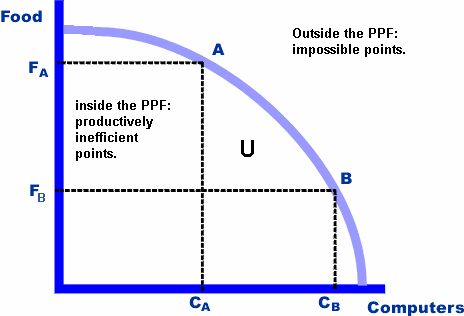

The central problem of an economy are:
-what to produce.
-how much to produce
-for whom to produce
-economic growth.
The central problem can be explained with the help of the Production Possibility curve given above. According to the curve above, the economy, with the help of the available resources can either produce 12 units of food or 12 units of computers. According to the production possibility curve the same resources can be used to produce 11 units of food and a 5 units of computers. The other option is to produce 10 units of food and 6 units of computers. The opportunity cost of producing one additional unit of a computer is 1 unit of food. However, the opportunity cost of producing 10 instead of 9 computers (1 additional computer) is 3 units of food.
Thus, the Production Possibility curve indicates at what level the production is the most efficient leading to a better utilization of scarce resources.
8.Draw and define a production possibility curve and show the following situations on the diagram.
i.Full employment of resources.
ii.Under utilization of resources
iii.Growth of resources.
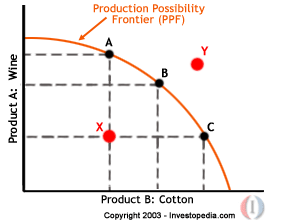
The Production Possibility Curve (PPC) represents the point at which an economy is most efficiently producing its goods and services and, therefore, allocating its resources in the best way possible. If the economy is not producing the quantities indicated by the PPC, then resources are being managed inefficiently and the production of society will dwindle. The Production Possibility Curve shows there are limits to production, so an economy, to achieve efficiency, must decide what combination of goods and services can be produced.
Let's turn to the chart above. Imagine an economy that can produce only wine and cotton. According to the PPF, points A, B and C - all appearing on the curve - represent the most efficient use of resources by the economy. Point X represents an inefficient use of resources, while point Y represents the goals that the economy cannot attain with its present levels of resources.
The outline of the curve (marked Production Possibility Frontier) represents full utilization of resources. Point Y in the chart (below) represents growth in the economy. More goods and services are being produced with a better utilization of resources.
However, point X in the chart above represents a point where resources are not being utilized properly.
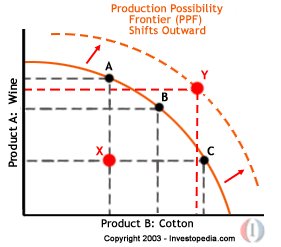
9.What is meant by economic growth? Differentiate between economic grow and
economic development.
Economic growth is defined as the increase in the per capital income of the country. The total production of good and services in an economy is termed as Gross National Product (GNP). However, increase in the GNP does not represent economic growth. This is because if there is GDP increase along with an increase in population then there is no real growth. Therefore, economic growth is defined as the increase in the per capita income. An increase in the per capital income leads to greater availability of goods and services in the hands of the people. Further, economic growth is in expressed in real terms. That is, per capita income has to be adjusted for inflation and must be for a sustained or prolonged period of time.
Economic development is different from economic growth. There may be economic growth by way of high increase in the per capita income. However, this per capita income may be concentrated in the hands of a few people. If this happens then there is no improvement in the standard of living of the people. Further the increase in the per capital income may be offset by inflation. Therefore, economic development is a long term growth of per capital income accompanied by reduction of poverty, inequality and unemployment. It includes improvement in material welfare, eradication of poverty, removal of illiteracy, disease and low lifespan.
10.Explain the concept of economic development.
Economic development is different from economic growth. There may be economic growth by way of high increase in the per capita income. However, this per capita income may be concentrated in the hands of a few people. If this happens then there is no improvement in the standard of living of the people. Further the increase in the per capital income may be offset by inflation. Therefore, economic development is a long term growth of per capital income accompanied by reduction of poverty, inequality and unemployment. It includes improvement in material welfare, eradication of poverty, removal of illiteracy, disease and low lifespan.
-Economic development is growth plus improvement in the standard of living.
-Economic growth refers to output. However, economic development refers to the composition of output an allocation of resources to the different sectors of the economy.
-Economic growth refers to the rise in income. However, economic development also refers to reduction in poverty, inequality, income and unemployment.
-Economic growth refers only to the indicator of income. Economic development also refers to non-economic indicators like literacy, health services etc.
-Economic growth is relatively easy to realize. However, economic development involves a lot of changes in society. It involves changes in social structure, attitudes, institutions as well as acceleration of economic growth, eradication of poverty etc.
-Economic growth does not require as much government intervention as economic development. Economic development involves uplifting the living standards of the people of the country and therefore requires government intervention.
11.Explain briefly the different stages of economic growth.
The different stages of economic growth are:
a)Traditional Society: A traditional society is a stage of economic growth where there is absence of modern science and technology. There is low output and productivity and primitive methods of production. There is very low savings and investments. Agriculture is the most important activity of the society.
b)Pre-take off stage: In this stage some conditions for growth are created. People aspire for a higher standard of living. Values, social attitude and expectations of the people change. Enterprising people come forward to take risks. Investment in transportation and communications increases. There is an expansion of internal and external trade.
c)Take-off stage : Here the process of economic growth becomes self sustained. Growth takes place without much government interaction. There is a political revolution and a significant increase in savings and investment.
d)Drive to maturity : The economy becomes mature with a high level of per capita output. There is sustained economic growth over decades. Modern technology is applied to all sectors. Investment is over 10% of national income.
e)Age of mass consumption : This is the final stage of economic growth. The per capita income is high with a high standard of living. There is extensive use of consumer goods and use of house-hold gadgets. The attention of society moves from problems of production to problems of consumption.
1.Explain the economic problem of an economy.
The economic problems of an economy are :
a)Human wants are unlimited
b)There are limited resources to satisfy these wants.
c)Unlimited wants have to be fulfilled with limited resources.
Therefore the economy faces the problem of satisfying unlimited wants with limited resources by arranging its wants in the order of priority in which it has to be fulfilled.From these arises the question of what to produce, how to produce and for whom to produce.
a)What to produce: Since resources are limited an economy has to produce those commodities which are high on its list of priorities. Only if this is done will there be a greater satisfaction of wants. If resources were unlimited the question of what to produce would not arise at all. If the economy makes a mistake of producing the wrong commodities then there will be wastage as the commodities produced will not be able to satisfy wants and will have to be thrown away. What to produce also depends on the pattern of consumption. For example in North India people consume more wheat while in South India people consume more rice.
b)How to produce: Not only the economy has decide on what to produce but has to decide on how much of each commodity it has to produce. If the wrong quantities are produced then there will be wastage of scarce resources. Once it has been decided how much to produce then the question of how to produce also has to be answered. If the level of technical knowledge is high then an automated method of production can be used else manual production methods have to be used. The quantity of production will depend on the method of production. How to produce will also depend on the resources available. For example if labour is easily available then a manual method may be used else a mechanized method has to be used.
c)For whom to produce: Every part of the economy has different wants and different level of resources. So the economic question is what has to be produced for whom. This is a problem of distribution. For example if the amount of wheat that can be produced is limited, then should it be distributed through Fair Price Shops ( Ration Shops) or sold for the more affluent people through regular shops.
2.Explain the factors that lead to economic problems.
The factors that lead to economic problems are:
a)Human wants are unlimited
b)The resources available to satisfy these are limited.Not only are human wants unlimited but wants keep increasing over a period of time.Further, as soon as on want is satisfied other wants crop-up. The main factor that lead to economic problems, therefore, is how to satisfy unlimited wants with limited means.
3.What do you understand by and economic problem? Can you think of an economy without and economic problem? Explain your answer.
An economic problem is a problem of too many wants and too few resources available to satisfy these wants. An economic problem can also be explained as the problem of what to produce, where to produce, how to produce and how much to produce. There is no economy without economic problems.
However, different economies have different economic problems. For example some part of Africa’s main economic problem is the scarcity of food and the non-availability of resources to produce the required food. The United States of America faces the problem of very high consumption of consumer goods. It faces the economic problems of people borrowing to consume. This leads to default in the repayment of loans. Default in repayment of loans leads to the economic problem of bankruptcy of financial institutions. A country like Singapore faces the economic problem of a shortage of skilled manpower. Every country faces its own economic problem.
There cannot be any economy without any economic problems. This is because no country has unlimited supply of resources. In order to meet their needs, each country has to depend on the resources of other countries. Even the USA has to depend on oil imported from the Middle East. Economic problems cannot be solved but restricted through good economic policies.
4.“Scarcity is the root of the problem of choice which every economy has to face? Discuss.
Scarcity is the root problem of choice which every economy has to face. This is because every economy has unlimited wants but only limited resources to satisfy these wants. All wants cannot be satisfied only because of limited resources.
Therefore, in order to satisfy wants, wants have to prioritized into important and less important want. Limited resources are then used to satisfy the more important wants first. If resources were not limited then all wants could have been satisfied together.Therefore, scarcity is the root problem of choice which every economy has to face.
5.Explain the central problems of an economy. Do all economies have similar central problems.
The central problems of an economy are as under :
-What and how much to produce: Every economy has to decide what to produce and how much to produce. What to produce has to be decided because limited resources cannot produce everything that is required. Only those goods which can satisfy the wants of the people better must be produced. Every economy has to decided how much of its resources must be used to produce guns and how much of it must be use to produce food. Not only that, each economy has to decide how much of each good is to be produced. If it is produced too little then there will be unfulfilled wants. If too much is produced then there will be wastage.
- How to produce : The economy must also decide how to produce. It has to decide on the choice of the technique of production. Each economy has to use a combination of resources like land, labour and capital to produce in a most efficient manner. The combination of resources used also depends upon the level of technical knowledge available in the county. If the level of technical knowledge is high then more capital and less labour may be used for production. If manpower is cheap then more manpower may be used.
-For whom to produce: This is a problem of distribution. The sum total of goods produced in the country is distributed among its population. Goods are produced for those who can afford to buy them.
-Fuller utilization of resources: Since resources are scarce, the available resources have to be fully utilized. Not utilizing resources is a waste of scarce resources. For example unemployment is a waste of scarce labour resources. Unemployment of scarce resources means the capacity to produce scarce goods goes waste and the economy does not get the benefit of the goods and services that could have been produced with these resources.
-Efficiency in utilization of resources: Each economy has to use resources efficiently. Efficient use of resources will avoid the wastage of scarce resources. Efficiency in the use of resources is defined as “when the economy cannot produce more of one commodity without producing less of another.”
-Economic Growth : Every economy faces the problem of economic growth. Every economy has to increase its ability to produce more goods and services with the available resources. If there is higher economic growth then the standard of living of people will improve. Economic growth is measured in term of Per Capita Income.
These central problems of an economy are common to all economies. Only the
method of resolving these varies from economy to economy. In a capitalist
economy these are resolved with the help of the “price mechanism”. In a socialist
economy these are resolved by the Central Planning Authority.
6.What is a production possibility curve? Upon what assumptions is it based? Explain its characteristics (shape).
A Production Possibility Curve is a diagram, which slopes downwards towards the right which explains nature of economic problem which arises due to the scarce resources which has alternate uses. It states schematically how much of two different commodities the society can produce with available resources. The assumptions of the Production Possibility Curve are:
- The amount of resources a society has is fixed.
- There is no change in technology.
- All productive resources are fully employed.
- Resources are not equally efficient in the production of all goods.
The characteristics (shape ) is :
-It slopes downwards towards the right : This indicates that that economy may give up the production of some items in order to produce some others. This is assuming that only limited resources are available and are utilized in the best manner.
- It is concave from the origin: The concave nature of the curve indicates the increasing opportunity cost. The opportunity cost of one commodity is the units of the other commodity which cannot be produced in order to produce one unit of a commodity. The opportunity cost keeps increasing since available resources cannot produces all goods with the same efficiency.
7.Illustrate the central problems of an economy with the help of production possibility curve.
The central problem of an economy are:
-what to produce.
-how much to produce
-for whom to produce
-economic growth.
The central problem can be explained with the help of the Production Possibility curve given above. According to the curve above, the economy, with the help of the available resources can either produce 12 units of food or 12 units of computers. According to the production possibility curve the same resources can be used to produce 11 units of food and a 5 units of computers. The other option is to produce 10 units of food and 6 units of computers. The opportunity cost of producing one additional unit of a computer is 1 unit of food. However, the opportunity cost of producing 10 instead of 9 computers (1 additional computer) is 3 units of food.
Thus, the Production Possibility curve indicates at what level the production is the most efficient leading to a better utilization of scarce resources.
8.Draw and define a production possibility curve and show the following situations on the diagram.
i.Full employment of resources.
ii.Under utilization of resources
iii.Growth of resources.
The Production Possibility Curve (PPC) represents the point at which an economy is most efficiently producing its goods and services and, therefore, allocating its resources in the best way possible. If the economy is not producing the quantities indicated by the PPC, then resources are being managed inefficiently and the production of society will dwindle. The Production Possibility Curve shows there are limits to production, so an economy, to achieve efficiency, must decide what combination of goods and services can be produced.
Let's turn to the chart above. Imagine an economy that can produce only wine and cotton. According to the PPF, points A, B and C - all appearing on the curve - represent the most efficient use of resources by the economy. Point X represents an inefficient use of resources, while point Y represents the goals that the economy cannot attain with its present levels of resources.
The outline of the curve (marked Production Possibility Frontier) represents full utilization of resources. Point Y in the chart (below) represents growth in the economy. More goods and services are being produced with a better utilization of resources.
However, point X in the chart above represents a point where resources are not being utilized properly.
9.What is meant by economic growth? Differentiate between economic grow and
economic development.
Economic growth is defined as the increase in the per capital income of the country. The total production of good and services in an economy is termed as Gross National Product (GNP). However, increase in the GNP does not represent economic growth. This is because if there is GDP increase along with an increase in population then there is no real growth. Therefore, economic growth is defined as the increase in the per capita income. An increase in the per capital income leads to greater availability of goods and services in the hands of the people. Further, economic growth is in expressed in real terms. That is, per capita income has to be adjusted for inflation and must be for a sustained or prolonged period of time.
Economic development is different from economic growth. There may be economic growth by way of high increase in the per capita income. However, this per capita income may be concentrated in the hands of a few people. If this happens then there is no improvement in the standard of living of the people. Further the increase in the per capital income may be offset by inflation. Therefore, economic development is a long term growth of per capital income accompanied by reduction of poverty, inequality and unemployment. It includes improvement in material welfare, eradication of poverty, removal of illiteracy, disease and low lifespan.
10.Explain the concept of economic development.
Economic development is different from economic growth. There may be economic growth by way of high increase in the per capita income. However, this per capita income may be concentrated in the hands of a few people. If this happens then there is no improvement in the standard of living of the people. Further the increase in the per capital income may be offset by inflation. Therefore, economic development is a long term growth of per capital income accompanied by reduction of poverty, inequality and unemployment. It includes improvement in material welfare, eradication of poverty, removal of illiteracy, disease and low lifespan.
-Economic development is growth plus improvement in the standard of living.
-Economic growth refers to output. However, economic development refers to the composition of output an allocation of resources to the different sectors of the economy.
-Economic growth refers to the rise in income. However, economic development also refers to reduction in poverty, inequality, income and unemployment.
-Economic growth refers only to the indicator of income. Economic development also refers to non-economic indicators like literacy, health services etc.
-Economic growth is relatively easy to realize. However, economic development involves a lot of changes in society. It involves changes in social structure, attitudes, institutions as well as acceleration of economic growth, eradication of poverty etc.
-Economic growth does not require as much government intervention as economic development. Economic development involves uplifting the living standards of the people of the country and therefore requires government intervention.
11.Explain briefly the different stages of economic growth.
The different stages of economic growth are:
a)Traditional Society: A traditional society is a stage of economic growth where there is absence of modern science and technology. There is low output and productivity and primitive methods of production. There is very low savings and investments. Agriculture is the most important activity of the society.
b)Pre-take off stage: In this stage some conditions for growth are created. People aspire for a higher standard of living. Values, social attitude and expectations of the people change. Enterprising people come forward to take risks. Investment in transportation and communications increases. There is an expansion of internal and external trade.
c)Take-off stage : Here the process of economic growth becomes self sustained. Growth takes place without much government interaction. There is a political revolution and a significant increase in savings and investment.
d)Drive to maturity : The economy becomes mature with a high level of per capita output. There is sustained economic growth over decades. Modern technology is applied to all sectors. Investment is over 10% of national income.
e)Age of mass consumption : This is the final stage of economic growth. The per capita income is high with a high standard of living. There is extensive use of consumer goods and use of house-hold gadgets. The attention of society moves from problems of production to problems of consumption.
Subscribe to:
Posts (Atom)